DEF 14A: Definitive proxy statements
Published on May 8, 2026
UNITED STATES
SECURITIES AND EXCHANGE COMMISSION
Washington, D.C. 20549
Proxy Statement Pursuant to Section 14(a)
of the Securities Exchange Act of 1934
|
Filed by the Registrant |
☑ |
|
Filed by a Party other than the Registrant |
☐ |
Check the appropriate box:
|
☐ |
Preliminary Proxy Statement |
|
☐ |
Confidential, For Use of the Commission Only (as permitted by Rule 14a−6(e)(2)) |
|
☑ |
Definitive Proxy Statement |
|
☐ |
Definitive Additional Materials |
|
☐ |
Soliciting Material under §240.14a−12 |
(Name of Registrant as Specified In Its Charter)
(Name of Person(s) Filing Proxy Statement, if Other Than the Registrant)
Payment of Filing Fee (Check all boxes that apply):
|
☑ |
No fee required. |
|
☐ |
Fee paid previously with preliminary materials. |
|
☐ |
Fee computed on table in exhibit required by Item 25(b) per Exchange Act Rules 14a-6(i)(1) and 0-11. |

2026 Proxy Statement and
Notice of Annual Meeting of Stockholders
|
Thursday, June 25, 2026
Online at: www.virtualshareholdermeeting.com/SKIL2026 |

|
300 Innovative Way, Suite 2210 Nashua, NH 03062 |
May 8, 2026 |
Dear Fellow Stockholders:
You are cordially invited to attend the 2026 Annual Meeting of Stockholders of Skillsoft Corp., which will be held at 3:00 p.m., Eastern Time, on Thursday, June 25, 2026. The Annual Meeting will be a completely virtual meeting of stockholders conducted via live webcast. You will be able to attend the Annual Meeting by visiting www.virtualshareholdermeeting.com/SKIL2026 and using a 16-digit control number included in your proxy materials.
Whether or not you plan to attend the Annual Meeting, it is important that your shares be represented and voted at the Annual Meeting. After reading the Proxy Statement, please promptly vote. You may vote your shares by Internet, telephone, or mail (if you requested and received a paper proxy card or voter instruction form), as instructed by your broker, or electronically at the Annual Meeting.
|
Sincerely,
Ronald W. Hovsepian Executive Chair and Chief Executive Officer |
Skillsoft Corp.
300 Innovative Way, Suite 2210
Nashua, NH 03062
NOTICE OF ANNUAL MEETING OF STOCKHOLDERS
|
Date: |
June 25, 2026 |
Record Date: |
May 4, 2026 |
|
Time: |
3:00 p.m. ET |
Attendance: |
www.virtualshareholdermeeting.com/SKIL2026 |
To the Stockholders of Skillsoft Corp.:
We will hold the 2026 Annual Meeting of Stockholders (the “Annual Meeting”) of Skillsoft Corp. (the “Company,” “Skillsoft,” “we,” “us,” or “our”) on June 25, 2026, at 3:00 p.m. Eastern Time as a virtual meeting held entirely over the Internet. You will be able to attend the Annual Meeting, vote your Class A Common Shares (“common stock”) electronically, and submit your questions online by visiting www.virtualshareholdermeeting.com/SKIL2026 and entering the 16-digit control number included in the notice containing instructions on how to access our proxy materials, your proxy card (the “Proxy Card”), or the voting instructions that accompanied the proxy materials.
|
Items of Business: |
|
1. |
To elect as Class II directors the three nominees named in the accompanying Proxy Statement to a term of three years each, or until their successors have been elected and qualified; |
|
2. |
To approve, on an advisory basis, the compensation of our named executive officers; |
|
3. |
To approve the Second Amendment to the Skillsoft Corp. 2020 Omnibus Incentive Plan to increase the number of shares of common stock available for issuance thereunder; |
|
4. |
To ratify the appointment of Ernst & Young LLP as our independent registered public accounting firm for the fiscal year ending January 31, 2027; |
|
5. |
To approve the adjournment of the Annual Meeting, to a later date or dates, if necessary or appropriate, as determined by the Board in its sole discretion, to solicit additional proxies if there are insufficient votes at the time of the Annual Meeting to approve the presented proposals or to constitute a quorum; and |
|
6. |
To transact any other business that properly comes before the Annual Meeting or any adjournment or postponement thereof. |
These matters are more fully described in the proxy statement accompanying this notice (the “Proxy Statement”).
We are pleased to take advantage of Securities and Exchange Commission (“SEC”) rules that allow us to furnish our Proxy Materials, consisting of the Notice of Annual Meeting, the Proxy Statement and a Proxy Card, and our Annual Report to Stockholders for the fiscal year ended January 31, 2026 (“Annual Report”), via the Internet. On or about May 8, 2026, we are mailing to stockholders of record as of the close of business on May 4, 2026 (the “record date”) a Notice of Internet Availability of Proxy Materials with instructions on how to access our Proxy Materials and vote via the Internet, by mail, or by telephone. The notice also contains instructions on how to request a paper copy of our Proxy Materials, including our Annual Report. This process allows us to provide our stockholders with the information they need on a more timely basis, while reducing the environmental impact and lowering the costs of printing and distributing our Proxy Materials.
Your vote is important. Whether or not you expect to attend the Annual Meeting, the Board encourages you to review the accompanying Proxy Statement for information relating to each of the proposals and to cast your vote promptly.
|
By Order of the Board, Ronald W. Hovsepian Executive Chair and Chief Executive Officer May 8, 2026
|
Important Notice Regarding the Availability of Proxy Materials for the 2026 Annual Meeting of Stockholders to be held on June 25, 2026. The Proxy Statement and Skillsoft’s Annual Report for fiscal 2026 are available at www.proxyvote.com.
CAUTIONARY NOTES REGARDING FORWARD-LOOKING STATEMENTS
This Proxy Statement may include statements that are, or may be deemed to be, “forward-looking statements” within the meaning of Section 27A of the Securities Act of 1933, as amended, and Section 21E of the Securities Exchange Act of 1934, as amended. For all such statements, we claim the protection of the safe harbor for forward-looking statements provided by such sections and the Private Securities Litigation Reform Act of 1995. All statements, other than statements of historical facts, are forward-looking statements. These forward-looking statements include, but are not limited to, statements that address activities, events or developments that we expect or anticipate may occur in the future, including such things as our outlook, our product development and planning, our pipeline, future capital expenditures, share repurchases, financial results, the impact of regulatory changes, our current and evolving business strategies, including with respect to acquisitions and dispositions, demand for our services, our competitive strengths, the benefits of new initiatives, growth of our business and operations, the effectiveness of our products, the outcomes of litigation proceedings and claims, the state and future of skilling in the workplace, our ability to successfully implement our plans, strategies, objectives, and our expectations and intentions. Forward-looking statements may, without limitation, be preceded by, followed by, or include words such as “may”, “will”, “would”, “anticipate”, “believe”, “estimate”, “expect”, “intend”, “plan”, “project”, “forecast”, “seek”, “outlook”, “target”, goal”, “objective”, “potential”, “possible”, “probably”, or similar expressions, or employ such future or conditional verbs as “may”, “might”, “will”, “could”, “should” or “would,” or may otherwise be indicated as forward-looking statements by grammatical construction, phrasing or context. Such statements are based upon the current beliefs and expectations of Skillsoft’s management and are subject to significant risks and uncertainties. Actual results may differ materially from those set forth in forward-looking statements. All forward-looking disclosures are speculative by their nature, and we caution you against unduly relying on forward-looking statements.
Factors that could cause or contribute to such differences include those described under “Part I - Item 1A. Risk Factors” and “Part II, Item 7 – Management’s Discussion and Analysis of Financial Condition and Results of Operations” of the Company’s Annual Report on Form 10-K for the fiscal year ended January 31, 2026 (the “2026 Form 10-K”) as well as the Company’s subsequent Quarterly Reports on Form 10-Q as applicable. These factors should not be construed as exhaustive and should be read in conjunction with the other cautionary statements included in the 2026 Form 10-K and in our other periodic filings with the SEC. The forward-looking statements contained in this Proxy Statement represent our estimates only as of the date of this Proxy Statement and should not be relied upon as representing our estimates as of any subsequent date. While we may elect to update these forward-looking statements in the future, we specifically disclaim any obligation to do so, whether to reflect actual results, changes in assumptions, changes in other factors affecting such forward-looking statements, or otherwise, except as required by law.
Although we believe that the assumptions underlying our forward-looking statements are reasonable, any of these assumptions, and therefore also the forward-looking statements based on these assumptions, could themselves prove to be inaccurate. Given the significant uncertainties inherent in any forward-looking statements included in this document, our inclusion of this information is not a representation or guarantee by us that our objectives and plans will be achieved. Any annualized, pro forma, projected and estimated numbers are used for illustrative purposes only, are not forecasts and may not reflect actual results.
Our Board is furnishing this Proxy Statement to solicit your proxy for the 2026 Annual Meeting of Stockholders (“Annual Meeting”) of Skillsoft Corp. (the “Company”, “Skillsoft”, “we”, or “our”). On or about May 8, 2026, we are mailing to holders of our Class A Common Stock, par value $0.0001 per share (“common stock”) of record at the close of business on May 4, 2026 (the “record date”) a Notice of Internet Availability of Proxy Materials (the “Notice”) with instructions on how to access our Proxy Materials and vote via the Internet, by telephone, or by mail. Our Proxy Materials consist of the Notice of Annual Meeting, this Proxy Statement and Proxy Card, and our Annual Report to Stockholders for the fiscal year ended January 31, 2026 (“Annual Report”).
This summary highlights information that is contained elsewhere in this Proxy Statement, and provides context related to the matters to be voted on at the Annual Meeting. It does not include all information necessary to make a voting decision and you should read this Proxy Statement in its entirety before casting your vote. Note that throughout this Proxy Statement: (i) “fiscal 2026” and “fiscal 2025” refers to the Company’s fiscal year ended January 31, 2026, and January 31, 2025, respectively; and (ii) “2026 Form 10-K” refers to the Company’s Annual Report on Form 10-K for the fiscal year ended January 31, 2026.
Annual Meeting Information
|
Date: |
June 25, 2026 |
Record Date: |
May 4, 2026 |
|
Time: |
3:00 p.m. ET |
Attendance: |
www.virtualshareholdermeeting.com/SKIL2026 |
|
Skillsoft at a Glance |
Skillsoft provides a skills management platform and associated learning solutions that are designed to help organizations manage the human and artificial intelligence (“AI”) skills lifecycle, including visibility into the skills they have and the skills they need, closing skills gaps, matching skills to work, and understanding how skills development impacts business performance. In fiscal 2026, we evolved from a content-centric model to an integrated skills management platform, where we leveraged our market-leading curated learning content and connected it to capabilities in content creation, skills benchmarking, AI-assisted learning, and role-based development journeys.
Skillsoft’s principal executive offices are located at 300 Innovative Way, Suite 2210, Nashua, NH 03062.
|
Fiscal Year 2026 Business Highlights* |
|
● |
Total GAAP Revenue of $513 million compared to $531 million in the prior year. |
|
|
● |
GAAP Net Loss of $140 million compared to GAAP Net Loss of $122 million in the prior year. GAAP Net Loss per share of $16.27 compared to GAAP Net Loss per share of $14.87 in the prior year. |
|
|
● |
Non-GAAP Adjusted EBITDA of $110 million, reflecting a Non-GAAP Adjusted EBITDA margin of 21% of GAAP Revenue, compared to $109 million and a margin of 21% of GAAP Revenue in the prior year. |
|
|
● |
Skillsoft announced the general availability of its next-generation skills management platform to power enterprise workforce readiness and outcomes. |
|
|
● |
Skillsoft and edX formed a strategic partnership to expand university-led learning in The Skillsoft Percipio® Platform, strengthening how enterprises build workforce readiness for an AI-driven world. |
|
|
● |
Ended the fiscal year with a strong balance sheet and liquidity profile to support our strategic investment priorities and future growth objectives, with cash, cash equivalents and restricted cash of $104.5 million as of January 31, 2026, and for fiscal 2026, GAAP net cash provided by operating activities of $25.1 million and non-GAAP free cash flow of $6.5 million. |
* See Appendix A for definitions, uses and reconciliations of non-GAAP financial measures to the most directly comparable GAAP financial measures.
|
Proposals |
Board Vote |
Page |
|
1. Election of three Class II directors |
FOR each nominee |
|
|
2. Approve, on an advisory basis, the compensation of our named executive officers |
FOR |
|
|
3. Approve the Second Amendment to the Skillsoft Corp. 2020 Omnibus Incentive Plan to increase the number of shares of common stock available for issuance thereunder |
FOR |
|
|
4. Ratify appointment of Ernst & Young LLP as our independent registered public accounting firm for fiscal 2027 |
FOR |
|
|
5. To approve the adjournment of the Annual Meeting, to a later date or dates, if necessary or appropriate, as determined by the Board in its sole discretion, to solicit additional proxies if there are insufficient votes at the time of the Annual Meeting to approve the presented proposals or to constitute a quorum |
FOR |
Proposal No. 1: Class II Director Election
We are asking you to vote for the election of Michael S. Klein, Denis Nikolaev, and Arthur Gilliland as Class II directors, each to serve for a three-year term expiring at the 2029 Annual Meeting. Our Board currently consists of nine members and is divided into three classes, each of which has a three-year term.
Proposal No. 2: Advisory Vote on Executive Compensation (Say-On-Pay)
We are asking you to vote to approve, on an advisory (nonbinding) basis, the compensation of our named executive officers (“NEOs”) as disclosed in this Proxy Statement. This proposal, commonly known as a “say-on-pay” proposal, gives our stockholders the opportunity to express their views on the compensation of our NEOs. This vote is not intended to address any specific item of compensation, but rather the overall compensation of our NEOs and the philosophy, policies, and practices described in this Proxy Statement.
Proposal No. 3: Approval of the Second Amendment to the Skillsoft Corp. 2020 Omnibus Incentive Plan to Increase the Number of Shares of Common Stock Available for Issuance Thereunder
We are asking you to approve an amendment (the “Second Amendment”) to the Skillsoft Corp. 2020 Omnibus Incentive Plan (the “2020 Plan”), to increase the aggregate number of shares of our common stock available for issuance thereunder from 3,755,658 shares to 4,305,658 shares.
Proposal No. 4: Ratification of Independent Auditors
We are asking you to ratify our Audit Committee’s appointment of Ernst & Young LLP as our independent registered public accounting firm for the fiscal year ending January 31, 2027. Although stockholder ratification of the appointment of Ernst & Young LLP to serve as our independent registered public accounting firm is not required by law or our organizational documents, the Board has determined that it is desirable to seek stockholder ratification as a matter of good corporate governance in the view of the critical role played by independent registered public accounting firms in maintaining the integrity of financial controls and reporting.
Proposal No. 5: Adjournment of Annual Meeting
We are asking you to approve the adjournment of the Annual Meeting to a later date or dates, if necessary or appropriate, as determined by the Board of Directors in its discretion, to permit further solicitation and vote, of proxies if, based upon the tabulated votes at the time of the Annual Meeting, there are insufficient shares represented (either in person, or by proxy) and entitled to vote, to constitute a quorum necessary to conduct business at the Annual Meeting or to approve any of the foregoing proposals.
Any business may be transacted at the adjourned meeting (at which a quorum shall be present or represented) which might have been transacted at the meeting originally noticed. If the adjournment is for more than 30 days, or if after the adjournment a new record date is fixed for the adjourned meeting, a notice of the adjourned meeting shall be given to each stockholder of record entitled to vote at the meeting. We do not currently intend to seek an adjournment of the Annual Meeting.
Other Proposals
The Board is not aware of any matters that will be brought before the Annual Meeting (other than procedural matters) that are not referred to on the enclosed Proxy Card. If any other business should properly come before the Annual Meeting, or any postponement or adjournment thereof, the persons named in the proxy will vote on such matters according to their best judgment. Discretionary authority to vote on such matters is conferred by such proxies upon the persons voting them.
IMPORTANT INFORMATION ABOUT THE ANNUAL MEETING AND VOTING
|
Attending the Annual Meeting |
You will be able to attend the Annual Meeting by visiting www.virtualshareholdermeeting.com/SKIL2026 and using your 16-digit control number included on the Notice, on your Proxy Card, or on the voting instruction form that accompanied your Proxy Materials to enter the meeting.
If your shares are registered directly in your name with our transfer agent, Continental Stock Transfer & Trust Company, you are considered the stockholder of record with respect to those shares, and the Notice or your Proxy Card (if requested), was sent directly to you. If your shares are held in a stock brokerage account or by a bank, trustee, or other nominee, you are considered the beneficial owner of shares held in street name, and your broker, bank, trustee, or other nominee is considered, with respect to those shares, the stockholder of record, and the Notice, your Proxy Card (if requested), or the voting instruction form are being forwarded to you by that organization.
We are holding the Annual Meeting as a virtual meeting because we believe that conducting the Annual Meeting as a virtual meeting is consistent with our commitment to innovation and will encourage higher levels of stockholder participation while also helping us reduce the environmental costs associated with the Annual Meeting. The Company designed the format of the virtual Annual Meeting to ensure that its stockholders who attend the Annual Meeting will be afforded the same rights and opportunities to participate as they would at an in-person meeting and to enhance stockholder access, participation, and communication through online tools. To ensure such an experience, the Company will provide stockholders with the ability to submit appropriate questions in real-time through the meeting website. Questions pertinent to Annual Meeting matters may be recognized and answered during the Annual Meeting at our discretion, in accordance with the rules of conduct for the meeting and subject to time constraints.
The virtual meeting platform is fully supported across major web browsers and multiple device types running the most updated version of applicable software and plugins. Participants should ensure that they have a strong internet connection wherever they intend to participate in the Annual Meeting. Online access to the audiocast will open approximately fifteen minutes prior to the start of the Annual Meeting. There will be no physical meeting location. The meeting will only be conducted via live audiocast. If you have any questions about accessing the virtual meeting website for the Annual Meeting, please contact Broadridge VSM support at 844-986-0822 / International: 303-562-9302. We will offer live technical support for all stockholders attending the Annual Meeting. If you encounter any technical difficulties with the virtual meeting during the log in or meeting time, please call the technical support number that will be posted on the virtual meeting log in page. Rules governing conduct at the Annual Meeting will be posted on the virtual meeting platform along with an agenda.
|
Stockholders Entitled to Vote |
The Board has set May 4, 2026 as the Record Date for the Annual Meeting. If you were the owner of our common stock at the close of business on the Record Date, you are entitled to vote at the Annual Meeting. You are entitled to one vote for each share of such common stock. At the close of business on the Record Date, there were 8,955,077 shares of our common stock issued, outstanding, and entitled to vote.
A list of stockholders of record entitled to vote at the Annual Meeting will be open to examination by any stockholder, for any purpose relevant to the Annual Meeting, during normal business hours for a period of ten days before the Annual Meeting at our principal executive office. If our offices are not generally open for any reason, stockholders may contact Investor Relations at investor.relations@skillsoft.com and arrangements will be made to review the records in person. The list will also be available during the virtual Annual Meeting for examination by any stockholder.
|
Quorum |
A majority of the voting power of our issued and outstanding shares of common stock and entitled to vote must be present at the Annual Meeting, either in attendance or by proxy, to hold the Annual Meeting and conduct business. This is called a “quorum.” Your shares will be counted as present at the Annual Meeting if you either attend our Annual Meeting or properly submit your proxy prior to the Annual Meeting. Shares that vote “abstain” or “withhold,” as well as broker non-votes (described below), will be counted as present for the purpose of determining the presence or absence of a quorum for the transaction of business at the Annual Meeting. Pursuant to the Company’s Bylaws, if less than a quorum is present at the Annual Meeting, the chairman of the meeting or stockholders holding a majority in voting power of the Company’s shares present in person or by proxy and entitled to vote thereon, have the power to adjourn the meeting from time to time without notice other than announcement at the meeting until a quorum shall be present.
|
Voting Methods |
Voting Before the Meeting
To vote your shares before the Annual Meeting, please follow the instructions for Internet or telephone voting on the Notice. If you request printed copies of the Proxy Materials by mail, (i) if you are the stockholder of record, you may also vote by signing and submitting your Proxy Card and returning it by mail, or (ii) if you are the beneficial owner but not the stockholder of record, you may also vote by signing the voter instruction form provided by your bank or broker, and returning it by mail. We encourage you to vote before the Annual Meeting even if you plan to attend the Annual Meeting, that way your shares will be represented whether or not you are able to attend the meeting.
Voting At the Meeting
Stockholders of record may vote and ask questions at the Annual Meeting by visiting www.virtualshareholdermeeting.com/SKIL2026. To participate in the Annual Meeting, you will need your 16-digit control number. Shares held in your name as the stockholder of record may be voted electronically during the Annual Meeting. Shares for which you are the beneficial owner but not the stockholder of record also may be voted electronically during the Annual Meeting by following the procedures provided by your nominee – see “Street Name Holders” below. However, even if you plan to attend the Annual Meeting, we recommend that you vote your shares in advance, so that your vote will be counted if you later decide not to attend the Annual Meeting.
Street Name Holders
If you are a beneficial owner who holds your shares in street name, you have the right to direct your broker, bank, trustee, or other nominee on how to vote the shares held in your account. Since a beneficial owner is not the stockholder of record, you may not vote your shares at the Annual Meeting unless you obtain a “legal proxy” from your broker, trustee or nominee that holds your shares, giving you the right to vote the shares at the Annual Meeting. Therefore, if you would like to participate in the Annual Meeting, vote, or ask a question, you should follow the instructions provided to you by that organization.
If you have any questions about how to vote or direct a vote of your shares, you may call Continental Stock Transfer & Trust Company at 1-800-509-5586 or our Investor Relations team at (603) 324-3000, or you may contact our proxy solicitor, Laurel Hill Advisory Group, at:
Laurel Hill Advisory Group
2 Robbins Lane, Suite 201
Jericho, New York 11753
Banks and Brokers Call (516) 933-3100
All Others Call Toll-Free (888) 742-1305
|
Vote Requirements |
Proposal No. 1: Director Nominee Election
For a director to be elected, the director must receive the affirmative vote of a plurality of the votes cast in the election in respect of the shares of stock present in person or represented by proxy at the Annual Meeting and entitled to vote on the election of directors.
Proposal No. 2: Advisory Vote on Executive Compensation (Say-On-Pay)
The affirmative vote of the majority of the voting power of the shares present or represented by proxy at the meeting and entitled to vote on the matter is required to approve, on an advisory basis, the compensation of our NEOs.
Proposal No. 3: Approval of the Second Amendment to the Skillsoft Corp. 2020 Omnibus Incentive Plan to Increase the Number of Shares of Common Stock Available for Issuance Thereunder
The affirmative vote of the majority of the voting power of the shares present or represented by proxy at the meeting and entitled to vote on the matter is required to approve the Second Amendment to the 2020 Plan.
Proposal No. 4: Ratification of Independent Auditor
The affirmative vote of the majority of the voting power of the shares present or represented by proxy at the meeting and entitled to vote on the matter is required to ratify our independent auditors.
Proposal No. 5: Approval of Adjournment of Annual Meeting
The affirmative vote of the majority of the voting power of the shares present or represented by proxy at the meeting and entitled to vote on the matter shall have the power to adjourn the meeting, regardless of whether a quorum is present.
|
How Your Shares will be Voted |
Proposal No. 1: You may vote “FOR” or “WITHHOLD” with respect to each director nominee. A “WITHHOLD” vote will have no effect on the outcome of the election of our directors in an uncontested election. Broker non-votes (described below) will have no effect on this proposal.
Proposal No. 2: You may vote “FOR,” “AGAINST,” or “ABSTAIN” with respect to the approval of our NEO’s compensation. An abstention will have the same effect as a vote “AGAINST” Proposal No. 2. Broker non-votes (described below) will have no effect on this proposal. If you abstain from voting on Proposal No. 2, your shares will be counted as present for purposes of establishing a quorum at the Annual Meeting. This vote is advisory and nonbinding on the Company.
Proposal No. 3: You may vote “FOR,” “AGAINST,” or “ABSTAIN” with respect to the approval of the Second Amendment to the 2020 Plan. An abstention will have the same effect as a vote “AGAINST” Proposal No. 3. Broker non-votes (described below) will have no effect on this proposal. If you abstain from voting on Proposal No. 3, your shares will be counted as present for purposes of establishing a quorum at the Annual Meeting.
Proposal No. 4: You may vote “FOR,” “AGAINST,” or “ABSTAIN” with respect to the ratification of our Audit Committee’s appointment of Ernst & Young LLP as our independent registered public accounting firm for the fiscal year ending January 31, 2027. An abstention will have the same effect as a vote “AGAINST” Proposal No. 4. Broker non-votes (described below) will have no effect on this proposal. However, as brokers, banks and other nominees may use their discretionary voting authority with respect to the ratification of our independent auditors, no broker non-votes are expected for this proposal. If you abstain from voting on Proposal No. 4, your shares will be counted as present for purposes of establishing a quorum at the Annual Meeting. This vote is advisory and nonbinding on the Company.
Proposal No. 5: You may vote “FOR,” “AGAINST,” or “ABSTAIN” with respect to the approval of the Adjournment of the Annual Meeting. An abstention will have the same effect as a vote “AGAINST” Proposal No. 5. Broker non-votes (described below) will have no effect on this proposal. If you abstain from voting on Proposal No. 5, your shares will be counted as present for purposes of establishing quorum at the Annual Meeting.
If you hold your shares in street name, your broker, bank, trust company or other nominee may vote your shares in its discretion on “routine” matters (Proposal No. 4) if you have not provided voting instructions. However, a broker/nominee cannot exercise its discretion to vote your shares on “non-routine” matters absent voting instructions from you. A “broker non-vote” occurs when shares held by a broker/nominee are not voted with respect to a particular proposal because the broker does not have discretionary authority to vote on the matter and has not received voting instructions from the beneficial owner. The election of directors, Say-On-Pay, Approval of the Second Amendment to the 2020 Plan, and adjournment of the Annual Meeting are “non-routine” matters. Therefore, if your shares are held in street name and you do not provide instructions to your broker or other nominee as to how to vote your shares on Proposals 1, 2, 3 or 5, your broker will not be able to vote your shares on these proposals. Your vote is important. We urge you to provide instructions to your broker so that your votes may be counted.
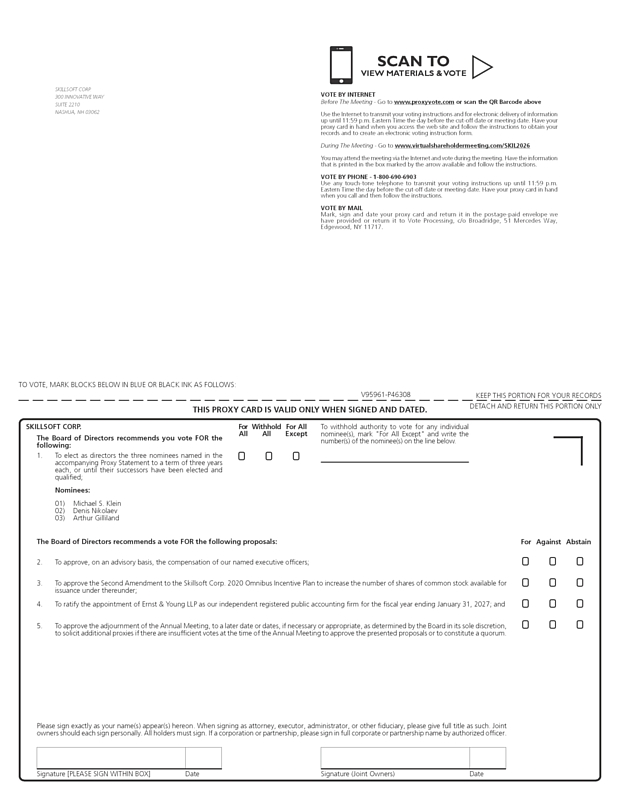
If you are a stockholder of record and you properly sign and return a Proxy Card, your shares will be voted as you direct.
If no instructions are indicated on a properly signed and returned Proxy Card and you are a stockholder of record, shares represented by the proxy will be voted in the manner recommended by the Board on all matters presented in this Proxy Statement, namely “FOR” for all director nominees, “FOR” the approval of the compensation of our NEOs, “FOR” the approval of the Second Amendment to the 2020 Plan, “FOR” the ratification of the appointment of Ernst & Young LLP as our independent registered public accounting firm for the fiscal year ending January 31, 2027, and “FOR” the approval of Adjournment of the Annual Meeting, if necessary to permit further solicitation and vote of proxies if, based upon the tabulated votes at the time of the Annual Meeting, there are insufficient shares of our capital stock represented, either in person or by proxy, and entitled to vote, to approve the presented proposals or to constitute a quorum necessary to conduct business at the Annual Meeting.
|
Revocation of Proxies |
Any proxy given by a stockholder of record pursuant to this Proxy Statement may be revoked by the person giving it at any time before the final vote at the Annual Meeting. If you are a stockholder of record, you may revoke your proxy and change your vote by: (i) voting again over the Internet or by telephone no later than 11:59 p.m., Eastern Time, on June 24, 2026, and following the instructions included in your Proxy Materials, or by signing and returning a new proxy card with a later date and returning it so that it is received by 11:59 p.m., Eastern Time, on June 24, 2026 ; (ii) attending and voting again (virtually) at the virtual Annual Meeting; or (iii) submitting written notice of revocation to our Corporate Secretary, Skillsoft Corp., 300 Innovative Way, Suite 2210, Nashua, NH 03062 so that it is received by 11:59 p.m., Eastern Time, on June 24, 2026. To request an additional Proxy Card, or if you have any questions about the Annual Meeting or how to vote or revoke your proxy, you should write to Investor Relations, Skillsoft Corp., 300 Innovative Way, Suite 2210, Nashua, NH 03062 or call (603) 324-3000. If you hold your shares in street name, contact your broker, bank, trust company or other nominee regarding how to revoke your proxy and change your vote. Please note that attendance alone at the Annual Meeting will not revoke a proxy; you must actually vote at the virtual Annual Meeting.
|
Solicitation of Proxies |
Our Board is making this solicitation and we will bear the entire cost of preparing, assembling, printing, mailing, and distributing the Proxy Materials and soliciting votes. Copies of solicitation materials may be furnished to brokers, custodians, nominees and other fiduciaries for forwarding to beneficial owners of common stock, and normal handling charges may be paid for such forwarding service. Officers and other of our employees, who will receive no additional compensation for their services, may solicit proxies by mail, email, via the Internet, personal interview, or telephone. We have also retained Laurel Hill Advisory Group to provide proxy solicitation services for a fee of $10,000 plus reimbursement of out-of-pocket expenses.
|
Tabulation |
Votes cast will be tabulated by the Inspector of Election appointed for the Annual Meeting. If you provide specific instructions on your proxy card, your shares will be voted as you instruct.
|
Results of the Annual Meeting |
We will announce voting results of the Annual Meeting in a Current Report on Form 8-K filed with the SEC no later than four business days after the Annual Meeting.
|
Questions |
If you have any questions about how to vote or direct a vote of your shares, you may call Continental Stock Transfer & Trust Company at 1-800-509-5586 or our Investor Relations team at (603) 324-3000, or you may contact our proxy solicitor, Laurel Hill Advisory Group, at:
Laurel Hill Advisory Group
2 Robbins Lane, Suite 201
Jericho, New York 11753
Banks and Brokers Call (516) 933-3100
All Others Call Toll-Free (888) 742-1305
PROPOSAL NO. 1: ELECTION OF CLASS II DIRECTORS
|
Overview |
Our Board consists of nine directors and is divided into three classes with staggered three-year terms. At the Annual Meeting, you will be asked to elect three Class II directors. Michael S. Klein, Denis Nikolaev, and Arthur Gilliland are the nominees for election at the Annual Meeting. If elected, each of the nominees will serve a three-year term expiring at the 2029 Annual Meeting, or upon such director’s earlier death, resignation, or removal from the Board.
The Nominating and Governance Committee has recommended, and the Board has approved, the nomination of each of these directors to stand for election as Class II directors at the Annual Meeting.
Each of the nominees has consented to serve if elected. However, if any of the nominees fails to stand for election, declines to accept election, or is otherwise unavailable for election prior to our Annual Meeting, proxies solicited by our Board will be voted by the proxy holders for the election of any other person or persons as the Board may recommend, or our Board, at its option, may reduce the number of directors that constitute the entire Board.
There are no material proceedings to which any director, officer or affiliate of the Company, any owner of record or beneficially of more than five percent of our common stock, or any associate of any such director, officer, affiliate of the Company, or security holder is a party adverse to the Company or any of its subsidiaries or has a material interest adverse to the Company or any of its subsidiaries. Other than as described under “Director Designation Rights” below, there are no arrangements or understandings with another person pursuant to which any of directors were selected as directors. There are no family relationships between any director, executive officer, or person nominated or chosen by the Company to become a director or executive officer.
|
Criteria for Nomination to the Board |
The Nominating and Governance Committee assesses the skills, experience, and attributes our Board should represent to align its individual and group strengths with our Company’s long-term strategic plan and the interests of our stockholders. The committee identifies director nominees using the criteria set forth below and any other criteria that may be identified in accordance with the committee’s charter:
|
• |
Background and Experience. The Nominating and Governance Committee seeks director nominees from a variety of professional and personal backgrounds who combine a broad spectrum of experience and expertise with a reputation for integrity. This assessment will include an individual’s independence, as well as consideration of age, skills, and experience, and a policy of promoting excellence, in the context of our needs. While our Board does not have a formal diversity policy, our Nominating and Governance Committee will take into account various factors and perspectives, including differences of viewpoint, personal and professional experience, education, skill and other individual qualities and attributes that contribute to Board heterogeneity. The Nominating and Governance Committee considers each potential nominee in the context of the Board as a whole, with the objective of assembling a Board that can best achieve and maintain the success of our business. The Nominating and Governance Committee periodically reviews the Board’s membership in light of our business model and strategic objectives, considers whether the directors possess the requisite skills, experience and perspectives to oversee the Company in achieving those goals, and may seek additional directors from time to time as a result of its considerations. |
|
• |
Character. Directors should be persons of good character and demonstrate high ethical standards and integrity in their personal and professional dealings. Directors should have a history of achievements which reflects high standards for themselves and others. Directors should possess the ability to provide wise and thoughtful counsel on a broad range of issues and be willing to be accountable for their decisions as directors. Directors should interact with one another in a manner which encourages responsible, open, challenging, and inspired discussion. |
|
• |
Sufficient Time to Devote to Board Matters. Each director is expected to dedicate sufficient time, energy, and attention to ensure the diligent performance of his or her duties. To that end, no director should serve on more than four other public company boards, and no member of the Audit Committee should serve on more than two other public company Audit Committees, in each case without the prior approval of the Board. No director who is the chief executive officer of another public company should serve on more than two other public company boards, aside from the board of his/her own company without the prior approval of the Board. |
Director Designation Rights
While certain directors are designated pursuant to the stockholder arrangements described below, our Board and Nominating and Governance Committee continue to assess the Board's overall composition, committee structure, and mix of skills and experience in light of the Company's strategic priorities and governance needs.
Skillsoft, Churchill Sponsor II LLC (the “Sponsor”), and Michael S. Klein are party to a Stockholders Agreement dated October 12, 2020 (the “Sponsor Stockholders Agreement”) pursuant to which the Sponsor, which solely for the purposes of the Sponsor Stockholder Agreement, means Mr. Klein, has the right to nominate two directors to our Board (the “Churchill Directors”) for so long as the Sponsor beneficially owns at least 5% of our common stock. If the Sponsor beneficially owns less than 5% of our common stock, the Sponsor has the right to nominate a single director to our Board for so long as the Sponsor beneficially owns at least 1% of our common stock. In addition, pursuant to the Sponsor Stockholders Agreement, we agreed to cause the Board to be comprised of nine directors and, as applicable, to appoint at least one director designated by the Sponsor to each committee of the Board for so long as the Sponsor beneficially owns more than 5% of our common stock. Mr. Klein currently serves as a Churchill Director.
Skillsoft, the Sponsor, and MIH Learning B.V. (“MIH”), as assignee of the rights and obligations of MIH Edtech Investments B.V., are party to a Subscription Agreement dated October 12, 2020 (the “MIH Subscription Agreement”) pursuant to which MIH has the right to nominate a number of directors to our Board (the “MIH Directors”) proportionate to MIH’s beneficial ownership of our common stock for so long as MIH beneficially owns at least 5% of our common stock. MIH has the right to designate no less than one director to our Board for so long as it beneficially owns at least 10% of our common stock, and no less than two directors to our Board for so long as it beneficially owns at least 20% of our common stock. Denis Nikolaev and Paul Peake currently serve as MIH Directors.
|
Identification and Evaluation Process Related to Director Nominations |
The Nominating and Governance Committee will recommend to the full Board the slate of the class of directors to be nominated for election at each annual meeting of stockholders and shall recommend additional candidates to fill vacancies as needed, in accordance with the procedures set forth below. In the case of incumbent directors whose terms of office are set to expire, the Nominating and Governance Committee reviews such directors’ overall service to the Company during their term, including the number of meetings attended, level of participation and quality of performance. In the case of new director candidates, the Nominating and Governance Committee first determines whether the candidate must be “independent” as defined by applicable securities laws, the rules and regulations of the SEC and applicable NYSE listing standards. The Nominating and Governance Committee will identify potential candidates and may also engage, if it deems appropriate, a professional third-party search firm. The Nominating and Governance Committee will then meet to discuss and consider such candidates’ qualifications in light of the overall composition of the Board, the operating requirements of the Company, the long-term interests of the stockholders and the criteria for nominee selection approved by the Board. Contact will be initiated with preferred candidates, including, to the extent the Nominating and Governance Committee deems necessary, the requirement of the completion of informational questionnaires provided by the committee to the candidate, as well as personal interviews of such candidates. After such procedure is complete, the Nominating and Governance Committee will meet to approve final candidates for recommendation to the full Board as set forth in its charter. In fiscal 2026, the Nominating and Governance Committee retained a third-party search firm specializing in the placement of candidates on corporate boards of directors to assist with identifying potential nominees to the Board who meet our qualification and experience requirements, and to perform initial due diligence on candidates so identified. Mr. Gilliland, who was appointed to our Board, upon the recommendation of our Nominating and Governance Committee, effective March 25, 2026, was identified as a potential director by such search firm.
|
Stockholder Nominations |
It is the policy of the Board to consider prospective board nominees recommended by stockholders. A stockholder who wishes to recommend a prospective board nominee for the Nominating and Governance Committee’s consideration must write to the Corporate Secretary at 300 Innovative Way, Suite 2210, Nashua, NH 03062, and include the nominee’s qualifications and other relevant biographical information, including age, employment history with employer names and a description of the employer’s business, whether such individual can read and understand basic financial statements, and board memberships (if any). The submission must be accompanied by a written consent of the individual to stand for election if nominated by the Board and to serve if elected by the stockholders. The Nominating and Governance Committee will evaluate the stockholder’s recommendation in the same manner as it evaluates other nominees. The Nominating and Governance Committee retains discretion in the recommendation of nominees to the Board, and except as set forth under “Director Designation Rights” above, has no obligation to nominate a candidate recommended by a stockholder or to include such candidate in the Company’s proxy materials. For deadlines and procedures applicable to nominees for inclusion in our proxy statement for our 2027 Annual Meeting of Stockholders, or the dates by which such nominations will be deemed untimely, see the heading “Stockholder Proposals and Nominations for the 2027 Annual Meeting of Stockholders.”
|
Board Qualifications |
The Nominating and Governance Committee has developed the following skills matrix which identifies the functional competencies, expertise and qualifications of the Company’s directors and nominees, and the competencies, expertise and qualifications that the Board would ideally possess:
|
Director Experience and Expertise |
Hovsepian |
Foulkes |
Frankola |
Gilliland |
Klein |
Mills |
Nikolaev |
Peake |
Schmitt |
|
Accounting/Financial Management |
☑ |
☑ |
☑ |
☑ |
☑ |
☑ |
|||
|
Human Capital Management |
☑ |
☑ |
☑ |
☑ |
☑ |
☑ |
☑ |
||
|
Corporate Governance |
☑ |
☑ |
☑ |
☑ |
☑ |
☑ |
☑ |
||
|
Cybersecurity |
☑ |
☑ |
|||||||
|
Marketing / Sales |
☑ |
☑ |
☑ |
☑ |
☑ |
||||
|
Mergers & Acquisitions |
☑ |
☑ |
☑ |
☑ |
☑ |
☑ |
☑ |
☑ |
|
|
Executive Leadership |
☑ |
☑ |
☑ |
☑ |
☑ |
☑ |
☑ |
☑ |
|
|
Global Business |
☑ |
☑ |
☑ |
☑ |
☑ |
☑ |
☑ |
☑ |
|
|
Strategy |
☑ |
☑ |
☑ |
☑ |
☑ |
☑ |
☑ |
☑ |
|
|
Technology / Innovation |
☑ |
☑ |
☑ |
☑ |
☑ |
||||
|
Artificial Intelligence |
☑ |
☑ |
|||||||
|
Industry Expertise |
☑ |
☑ |
☑ |
||||||
|
Corporate and Social Responsibility |
☑ |
☑ |
☑ |
☑ |
☑ |
||||
|
Data Privacy |
☑ |
☑ |
|||||||
|
Finance & Capital Markets |
☑ |
☑ |
☑ |
☑ |
☑ |
|
Nominees and Continuing Directors |
Biographical information for each person nominated for election as a director at the Annual Meeting and each person whose term of office as a director will continue after the Annual Meeting is set forth below, including age, term of office, and business experience, including directorships with publicly traded companies during the past five years. In addition, for each person, we have included information regarding the business or other experience, qualifications, attributes, or skills that factored into the determination by the Nominating and Governance Committee and our Board that each such person should continue to serve as a director.
|
OUR BOARD UNANIMOUSLY RECOMMENDS A VOTE “FOR” EACH OF THE CLASS II DIRECTOR NOMINEES LISTED BELOW. |
Class II Director Nominees
Michael S. Klein
|
Director Since: June 2021 Age: 62 |
Experience: Michael S. Klein has served as a member of the Board of Directors of Skillsoft Corp. since June 2021. He served as director of Churchill Capital Corp II, the predecessor listed company, and as well as the predecessor listed company’s Chief Executive Officer (from June 2019 to June 2021).
Mr. Klein serves as Managing Partner of M. Klein and Company, a leading global financial and strategic advisory firm he founded in 2012. He is the controlling stockholder of M Klein Associates, Inc., a private company founded in 2012 and is the founder and managing member of Garden State Capital Partners LLC, a private company founded in 2018.
Mr. Klein also currently serves as Chief Executive Officer and Chairman of Churchill Capital Corp IX (Nasdaq: CCIX) and Churchill Capital Corp. XI (Nasdaq: CCCXIU), publicly-traded special purpose acquisition companies whose sponsor is an affiliate of M. Klein and Company. In addition, Mr. Klein serves on the board of directors of Claritev (NYSE: CTEV), formerly known as Multiplan, Inc., a technology, data and insights company focused on healthcare, which merged with Churchill Capital Corp III in October 2020. Prior to the merger, he served as the Chief Executive Officer and Chairman of Churchill Capital Corp III (since February 2020). Mr. Klein also serves on the board of directors of Oklo, Inc. (NYSE: OKLO), a nuclear fuel recycling and fast fission power plant developer, which, in May 2024, merged with AltC Acquisition Corp., a publicly-traded special purpose acquisition company (“AltC”). Mr. Klein was the Chairman of the board of directors of Alt C (from 2021 to 2024).
Mr. Klein is also a director of Magic Leap, a private company specializing in transparent optics technology and highly-precise, scalable optics manufacturing (since 2020), TBG AG, a private investment company (since 2013), Evolution Media Capital, a private sports media financial advisory company (since 2024), and various charitable organizations.
Previously, Mr. Klein was the Co-Founder and Chairman of Churchill Capital Corp IV, a publicly-traded special purpose acquisition company formed in July 2020. Churchill Capital Corp IV merged with Lucid Motors (Nasdaq: LCID), a technology company focused on electric vehicles, in July 2021. Mr. Klein also served on the board of directors of Credit Suisse Group AG and Credit Suisse AG from 2018 until October 2022. He was also the co-founder and Chairman of Churchill Capital Corp, a publicly-traded special purpose acquisition company formed in 2018. Churchill Capital Corp merged with Clarivate Analytics in May 2019, and Mr. Klein served on the board of directors of Clarivate Plc. until October 2020. In addition, Mr. Klein previously served on the boards of Churchill Capital Corp V, VI, VII and X.
Mr. Klein is a strategic advisor to companies, governments, and investors, with over 30 years in investment banking, including senior leadership roles at Citi and Salomon Smith Barney. |
|
Education: Mr. Klein holds a BS from The Wharton School of the University of Pennsylvania, with concentrations in finance and accounting. |
|
|
Qualifications and Expertise: Mr. Klein was selected to serve on our Board based on his significant investment banking and strategic advisory experience. |
Denis Nikolaev
|
Independent
Director Since: November 2025
Age: 42 |
Experience: Mr. Nikolaev has served as a member of our Board since November 2025. Mr. Nikolaev is a Managing Director in the Investments team at Prosus N.V. and Naspers Ltd., a global consumer internet group and one of the world's largest technology investors and operators (together, “Prosus”) since September 2019. Prosus is also the largest stockholder of the Company (as the indirect owner of MIH). Mr. Nikolaev also currently serves as a member of the advisory board of GoStudent GmbH, a global online tutoring platform for children (since December 2021) and a member of the advisory board of Stack Exchange Inc., Stack Overflow GmbH, and Stack Overflow Limited (each since February 2021); the Stack Overflow companies comprise a global organization empowering developer communities to discover information, answers, and learning opportunities. All of the foregoing entities are Prosus portfolio companies.
Prior to his time at Prosus, Mr. Nikolaev worked as an investment banker at Citigroup in London (2008-2018) where he helped establish the Internet investment banking team. He was previously a member of the advisory boards at GoodBidco BV (May 2021 - August 2025) and EduMe Limited (December 2021 – August 2025), both Prosus portfolio companies. |
|
Education: Mr. Nikolaev holds a bachelor’s degree in economics from the London School of Economics and Political Science and a master’s degree from Saïd Business School at the University of Oxford. |
|
|
Qualifications and Expertise: Mr. Nikolaev was selected to serve on the Board based on his significant experience in the technology and internet industry. |
Arthur Gilliland
|
Independent
Director Since: March 2026
Age: 55
Committee Service: • Audit • Talent and Compensation (Chair) |
Experience: Mr. Gilliland has served as a member of the Board of Directors of Skillsoft Corp. Since March 2026.
Mr. Gilliland currently serves as the Chief Executive Officer of Delinea, Inc., a leader in identity security (since March 2021). Prior to Delinea, Mr. Gilliland was the Senior Vice President and General Manager of the Symantec Enterprise Division of Broadcom Inc. (NASDAQ: AVGO), a global technology leader that designs, develops and supplies semiconductor and infrastructure software solutions (from November 2019 to December 2020). Prior to this, Mr. Gilliland served as EVP and GM Enterprise Business Unit of Symantec Corporation (NASDAQ: SYMC) (from November 2018 to November 2019) until Symantec’s Enterprise business was acquired by Broadcom, Inc. Previously, Mr. Gilliland served as Chief Executive Officer and President of Skyport Systems, a SaaS managed secure infrastructure provider that was acquired by Cisco Systems (from July 2015 to February 2018). Prior to Skyport Systems, Mr. Gilliland served as Senior Vice President and General Manger, Enterprise Security Products, at Hewlett-Packard Enterprise Company, (NYSE: HPE), a leader in essential enterprise technology (from July 2012 to July 2015).
Mr. Gilliland has also served as a member of the Board of Directors of OneSpan (Nasdaq: OSPN) (from December 2017 to January 2019) and as a member of the Board of Directors of Gigamon (from May 2018 to January 2019). |
|
Education: Mr. Gilliland holds a bachelor’s degree in economics from Carleton College and an MBA from Harvard Business School. |
|
|
Qualifications and Expertise: Mr. Gilliland was selected to serve on our Board based on his proven track record of success in the global, enterprise software industry. |
Continuing Directors – Class III Directors, serving until the 2027 Annual Meeting of Stockholders
Helena B. Foulkes
|
Independent
Director Since: June 2021
Age: 61
Committee Service: • Audit • Talent and Compensation • Nominating and Governance |
Experience: Helena B. Foulkes has served as a member of the Board of Directors of Skillsoft Corp. since June 2021.
Ms. Foulkes is currently a member of the Board of Directors of Costco Wholesale Corporation (Nasdaq: COST), a membership warehouse club (since August 2023) where she is a member of the Audit Committee, the Executive Chair of PM Pediatrics, a business with 90 urgent care clinics supporting children (since 2023), the Executive Chair of the Board of Directors of Follett Higher Education Group, an educational service provider and omnichannel retailer (since 2022), and a member of the Board of Directors of Harry’s, Inc., a consumer packaged goods company (since 2000).
Previously, Ms. Foulkes served as the Chief Executive Officer and a member of the Board of Directors of Hudson’s Bay Company (“HBC”), a multinational retailer (from February 2018 to March 2020), and as a member of the Board of Directors of Home Depot, Inc. (NYSE: HD), a home improvement goods retailer (from September 2013 to October 2021). Prior to HBC, she served as Executive Vice President of CVS Health Corporation (NYSE: CVS), an integrated pharmacy health care provider and retailer (from 2014 to 2018), and President of CVS Pharmacy (2014 to 2018). At CVS, Ms. Foulkes also served as Executive Vice President and Chief Health Care Strategy and Marketing Officer, Executive Vice President and Chief Marketing Officer, Senior Vice President of Health Services of CVS Pharmacy, Senior Vice President, Marketing and Operations Services, and Senior Vice President, Advertising and Marketing. In addition, Ms. Foulkes held positions in Strategic Planning, Visual Merchandising, and Category Management during her 20-plus years with CVS. |
|
Education: Ms. Foulkes holds an AB from Harvard College and an MBA from Harvard Business School. |
|
|
Qualifications and Expertise: Ms. Foulkes was selected to serve on our Board based on her extensive business experience, including public company chief executive officer experience, marketing experience and her role as a board member of prominent companies. |
Karen G. Mills
|
Independent
Director Since: June 2021
Age: 72
Committee Service: • Audit • Nominating and Governance |
Experience: Karen G. Mills has served as a member of the Board of Directors of Skillsoft Corp. since June 2021. She served as director for Churchill Capital Corp II, Skillsoft’s predecessor listed company, since June 2019.
Ms. Mills has served as the President of Tootsie Roll Industries, Inc. and a member of its Board of Directors since June 2025. Ms. Mills is also the President of MMP Group since October 1993, which invests in financial services, consumer products, and technology-enabled solutions businesses. She also serves as Vice Chair of the National Bureau of Economic Research and is a member of the Harvard Corporation.
Ms. Mills was previously a Senior Fellow at the Harvard Business School (from January 2014 to 2025) focusing on economic policy, U.S. competitiveness, entrepreneurship, and innovation. Ms. Mills was previously a member of the Board of Directors of Clarivate Plc (NYSE: CLVT), a global provider of transformative intelligence (from May 2019 to January 2021). She was also a member of the Board of Directors of Churchill Capital Corp III and IV (from October 2020 to July 2021), Churchill Capital Corp V (from December 2020 to October 2023), Churchill Capital Corp VI (from February 2021 to December 2023) and Churchill Capital Corp VII (from February 2021 to August 2024). The Churchill group of companies are publicly-traded special purpose acquisition companies sponsored by an affiliate of M. Klein and Company.
In addition, Ms. Mills was a member of President Barack Obama’s Cabinet, serving as the Administrator of the U.S. Small Business Administration (from April 2009 to August 2013). |
|
Education: Ms. Mills holds an AB in Economics from Harvard University, Magna Cum Laude, and earned an MBA from Harvard Business School. |
|
|
Qualifications and Expertise: Ms. Mills was selected to serve on our Board based on her expertise in strategic and financial matters, business structure and growth, leadership, as well as her significant board of director experience. |
Paul Peake
|
Independent
Director Since: July 2024
Age: 43
Committee Service: • Talent and Compensation • Nominating and Governance |
Experience: Paul Peake has served as a member of the Board of Directors of Skillsoft Corp. since July 2024.
Mr. Peake serves as the General Counsel for Takeaway.com Group B.V. (since April 2026), a leading global on-demand delivery marketplace and a Prosus portfolio company. Prosus is a global consumer internet group and one of the world’s largest technology investors and operators, as well as the largest shareholder of the Company (at the indirect owner of MIH
Previously, Mr. Peake served as the General Counsel Food, B2C and Edtech for Prosus, where he oversaw all legal aspects of Prosus’ investments across food delivery, ecommerce and edtech (from January 2020 to April 2026). Previously he also served on the board of several privately held Prosus portfolio companies, including iFoods Holdings B.V., a food delivery company operating in Brazil (from September 2023 to April 2026) and Takealot Group, an ecommerce company based in South Africa (from March 2022 to April 2026) and Dante International SA, a leading Romanian ecommerce platform (from February 2023 to April 2026). He also previously served as a member of the Board of Directors of HeyBlu IFN S.A., a non-banking financial services company (from December 2022 to October 2023) and as a member of the supervisory board of Flink SE, an on-demand grocery delivery service based in Germany (from May 2023 to August 2024), each Prosus portfolio companies. Prior to his relationship with Prosus, Mr. Peake spent five years at eBay group holding various senior positions including Head of Legal for StubHub Inc.’s international business (from September 2014 to January 2020). Prior to eBay, he worked for global organizations including Federation Internationale de Football Association (FIFA), adidas, Volkswagen Group and the United Nations. Mr. Peake started his career as a private practice lawyer in London with Shoosmiths LLP.
Mr. Peake has more than 15 years of professional experience with more than a decade of experience holding senior positions in global internet companies. |
|
Education: Mr. Peake qualified as a lawyer from Nottingham Law School followed by a Master’s degree in EU Competition Law from King’s College London. |
|
|
Qualifications and Expertise: Mr. Peake was selected to serve on our Board based on his extensive business and legal experience, including in global internet companies. |
Continuing Directors ‐– Class I Directors, serving until the 2028 Annual Meeting of Stockholders
Ronald W. Hovsepian
|
Director Since: June 2021
Age: 65 |
Experience: Ronald W. Hovsepian is the Chief Executive Officer and Executive Chair of the Board of Directors of Skillsoft Corp. since April 2024. He has served as a director of Skillsoft Corp. since June 2021 and previously served on the Audit, Talent and Compensation, and Nominating and Governance Committees until April 2024. In addition, he was the Executive Chairman of Software Luxembourg, the Skillsoft predecessor entity from July 2018 to June 2021.*
Mr. Hovsepian also serves on the Board of Directors of Procore Technologies, Inc. (NYSE: PCOR), the leading global provider of construction management software, since December 2025, and on the Board of Directors of Sapio Sciences, LLC, an agentic AI lab informatics platform for biopharma research and development, clinical diagnostics and manufacturing, since April 2026. He has also been a member of the Board of Directors at ValoHealth since 2019 and served as Chairman for four years and has also been an executive partner at Flagship Pioneering, Inc., a venture capital firm focused on biotechnology and sustainability since October 2018.
Previously, he served as a chairman of the board of directors of Ansys Inc. (Nasdaq: ANSS), the global leader in engineering simulation (from 2019 to 2025), and previously served as its Lead Independent Director (from 2014 to 2019) and as non-executive Chairman (from 2014 to 2016). He also previously served as a director of Pegasystems Inc. (Nasdaq: PEGA), a software company empowering digital transformation (from January 2019 to June 2021). In addition, Mr. Hovsepian served as Chief Executive Officer of Indigo Ag, an agricultural technology company (from September 2020 to January 2024) and was previously a member of its Board of Directors (from 2019 to January 2024). Mr. Hovsepian was President and Chief Executive Officer of Intralinks, a global provider of secure SaaS collaboration solutions and virtual data rooms (from 2011 to 2017) and following its acquisition by Synchronoss Technologies, Inc. (Nasdaq GS: SNCR) served as Synchronoss’s Chief Executive Officer until April 2017. Prior to Intralinks, Mr. Hovsepian served as President and Chief Executive Officer of Novell, Inc., where he started as Executive Vice President and President, Worldwide Field Operations. Mr. Hovsepian began his career at IBM, where he held a number of management and executive positions over a 16-year period. |
|
Education: Mr. Hovsepian holds a BS from Boston College. |
|
|
Qualifications and Expertise: Mr. Hovsepian was selected to serve on our Board based on his extensive business experience in the technology sector, public company chief executive officer experience, and public company board experience, and his significant knowledge of Skillsoft from his prior service with the Skillsoft predecessor entity. |
*In June 2020, Software Luxembourg and specified affiliates (the “Skillsoft Prior Entities”) commenced voluntary “prepackaged” petitions for relief under Chapter 11 of the U.S. Bankruptcy Court for the District of Delaware. In August 2020, the Skillsoft Prior Entities completed a successful restructuring and emergence from Chapter 11.
Jim Frankola
|
Independent
Director Since: July 2024
Age: 61
Lead Independent Director
Committee Service: • Audit (Chair) • Talent and Compensation • Nominating and Governance (Chair) |
Experience: Jim Frankola has served as a member of the Board of Directors of Skillsoft Corp. since July 2024.
Mr. Frankola serves as a member of the Board of Directors and audit committee of IonQ (NYSE: IONQ), a leading commercial quantum computing and quantum networking company.
Previously, Mr. Frankola served as a member of the Board of Directors of 23andMe (NASDAQ:ME, later Chrome Holding Co OTC:MEHCQ), a leading human genetics and preventative health company (from October 2024 to December 2025), as a member of the Board of Directors and Chair of the Audit Committee of Ansys, Inc. (Nasdaq: ANSS), a global leader in engineering simulation (from March 2021 to July 2025), as a member of the Board of Directors of Cvent Holding Corp. (Nasdaq: CVT), a market-leading meetings, events and hospitality technology provider (from 2021 to 2023), and ActivIDentity Corporation, a credentials management and authentication company (from 2006 to 2010). He has also served as the Chief Financial Officer of Cloudera, Inc., an enterprise data cloud company (from 2012 to 2021) as well as Chief Financial Officer of Yodlee, Inc., a data aggregation and data analytics platform company (from 2010 to 2012) and the CFO of Ariba (from 2001-2008). Mr. Frankola has held various senior positions in financial and business management at several additional companies, including International Business Machines Corporation and Avery Dennison Corporation. In addition, Mr. Frankola serves as an advisor to early-stage artificial intelligence companies, Vectara and Narada. |
|
Education: Mr. Frankola holds a BS in Accounting from Penn State University and a Master’s degree in International Business and Finance from NYU Stern School of Business. |
|
|
Qualifications and Expertise: Mr. Frankola was selected to serve on our Board based on his extensive business experience in the technology sector, public company executive officer experience, and public company board experience. |
Peter Schmitt
|
Director Since: June 2021
Age: 59 |
Experience: Peter Schmitt has served as a member of the board of directors of Skillsoft Corp. since June 2021. He previously served as a director of Software Luxembourg, the Skillsoft predecessor entity, from August 2020 until June 2021.
Dr. Schmitt serves as Industrial Advisor at EQT Partners AB (“EQT Partners”), a global investment organization listed on Nasdaq Stockholm (since May 2018) and as President at MEC Advisors LLC, an advisory firm (since October 2017). He is on the advisory board of ThermoAnalytics, Inc., a global developer of thermal, fluid-flow, and infrared modeling software (since July 2019) as well as Acerta LinePulse (since January 2026), a purpose-built tool for discrete manufacturing processes using Industrial AI, and xSuite Group GmbH (since August 2022), a software manufacturer of intelligent applications automating document-based business processes, both 3i portfolio companies
Previously, Dr. Schmitt served on the board of MAIT GmbH, a provider of innovative and pioneering digital solutions (from 2021 to 2025), Innovyze LLC, a water infrastructure data analytics software provider, (from 2019 to 2021) and Zemax LLC, an optical design and simulation software provider (from 2018 to 2021), both EQT Partners portfolio companies which were sold in 2021, as well as Upchain, a cloud based product lifecycle management software company (from 2019 to 2021), which was also sold in 2021. He served on the advisory board of Blume Global, Inc., an Apollo portfolio company specializing in supply chain optimization, from 2021 until its sale in 2023. Dr. Schmitt previously served as Senior Vice President of IoT & Digital Twin at Cenit AG, a specialist in product lifecycle management, enterprise information management solutions and application management services listed on the Prime Standard of the German Stock Exchange (from 2018 to 2019). Prior to Cenit, Dr. Schmitt served as Executive Vice President of Global Sales & Operational Marketing at ESI Group (from 2015 to 2017) and Vice President at Dassault Systèmes (from 2000 to 2015). |
|
Education: Dr. Schmitt holds a Diplom Ingenieur (equivalent to Master of Engineering in Mechanical Engineering) from Technical University of Karlsruhe, Germany and a Doctorate degree in Manufacturing Engineering from the University of Stuttgart, Germany. |
|
|
Qualifications and Expertise: Dr. Schmitt was selected to serve on our Board based on his extensive business experience, including with international organizations, and his knowledge of Skillsoft from his prior service with the Skillsoft predecessor entity. |
CORPORATE GOVERNANCE AND OUR BOARD OF DIRECTORS
|
Board Leadership and Governance Structure |
The following table details certain basic information on our directors, the composition of the Board and its standing committees, and the number of meetings held during the fiscal year ended January 31, 2026.
|
Standing Committee Memberships |
||||||
|
Name |
Age |
Director Since |
Independent |
Audit |
Talent and Compensation |
Nominating and Governance |
|
Ronald W. Hovsepian |
65 |
2021 |
||||
|
Helena B. Foulkes |
61 |
2021 |
☑ |
☑ |
☑ |
☑ |
|
Jim Frankola |
61 |
2024 |
☑ |
© |
☑ |
© |
|
Arthur Gilliland |
55 |
2026 |
☑ |
☑ |
© |
|
|
Paul Peake |
43 |
2024 |
☑ |
☑ |
☑ |
|
|
Michael S. Klein |
62 |
2021 |
||||
|
Karen G. Mills |
72 |
2021 |
☑ |
☑ |
☑ |
|
|
Denis Nikolaev |
42 |
2025 |
☑ |
|||
|
Peter Schmitt |
59 |
2021 |
||||
|
FY 2026 Meetings |
Board: 5 |
4 |
7 |
3 |
||
|
☑= Member © = Chair |
||||||
Director Independence
The Board has determined that each of our directors and director nominees other than Mr. Hovsepian, who is also our Chief Executive Officer and Executive Chair, Mr. Klein, and Dr. Schmitt is “independent” as that term is defined under the New York Stock Exchange (“NYSE”) listing standards. In making these determinations, the Board considered the current and prior relationships that each non-employee director has with us and all other facts and circumstances deemed relevant in determining their independence, including the beneficial ownership of our capital stock by each non-employee director and the transactions involving them, including those related person transactions described in the section entitled “Certain Relationships and Related Person Transactions.”
Board Leadership Structure
Our Corporate Governance Guidelines provide that the Chairperson of the Board shall be elected by the Board. Pursuant to the MIH Subscription Agreement, the Board elected Ronald W. Hovsepian as the Chairperson of the Board (Executive Chair). The Board is free to elect another Chairperson at any time.
The Board has not adopted a policy requiring the CEO and Chairperson to be different persons. The Board believes that we and our stockholders are best served by maintaining flexibility to have any director serve as Chairperson and therefore believes that a permanent policy on whether the Chairperson and CEO positions should be separated or combined is not appropriate. However, an analysis of whether the Chairperson and CEO positions should be separated or combined is made on a periodic basis by the Board, which permits the Board to make changes to Board leadership that it believes are in the best interests of the Company and its stockholders. As a part of this process, the Board reviews whether the existing leadership structure provides strong independent oversight while balancing the need for extensive knowledge of business operations, risks and strategy implementation and accountability for Company performance.
In order to maintain the independent integrity of the Board, however, the Corporate Governance Guidelines provide that if the Chairperson is not an independent director, the Board shall appoint a Lead Independent Director who must be independent. Lawrence H. Summers served as the Lead Independent Director from August 2024 until his departure from the Board in November 2025. Jim Frankola was appointed as Lead Independent Director in March 2026. The Board is free to appoint another Lead Independent Director at any time.
The Lead Independent Director’s responsibilities include: (a) presiding at all meetings of the Board at which the Chairperson is not present, including executive sessions of the non-executive and/or independent directors; (b) serving as liaison between the Chairperson and the independent directors; (c) reviewing and approving materials to be sent to the Board; (d) approving the meeting agendas for the Board; (e) approving meeting schedules to assure that there is sufficient time for discussion of all agenda items; (f) having the authority to call meetings of the independent directors (which occur at least once every year); and (g) if requested by major stockholders, ensuring that he or she is available for consultation and direct communication. If the Chairperson is an independent director, then the foregoing responsibilities will be handled by the Chairperson.
The Board has considered our leadership structure in light of the Company’s size, the nature of our business, the regulatory framework in which we operate, and our peers and has determined that the Board’s leadership structure continues to be appropriate at this time. This structure of having a combined Chairman/CEO, counterbalanced with a Lead Independent Director with robust responsibilities and independent committee chairs, helps to ensure a unity of vision and strategy while still maintaining distinct roles of daily operations and oversight. The combined Chairman/CEO position also creates accountability to all stakeholders regarding the Company’s performance and risk management.
Board Size
The Board currently consists of nine directors. Our Certificate of Incorporation provides that the authorized number of directors may be changed only by resolution of the Board, subject to certain exceptions. Pursuant to the Sponsor Stockholders Agreement, we agreed to cause the Board to be comprised of nine directors. Any additional directorships resulting from an increase in the number of directors will be distributed among the three classes so that, as nearly as possible, each class will consist of one-third of the directors. The division of the Board into three classes with staggered three-year terms may delay or prevent a change of management or a change in control of Skillsoft.
|
Board Committees |
The Board has three standing committees: an Audit Committee, a Talent and Compensation Committee (the “Compensation Committee”), and a Nominating and Governance Committee. NYSE listing standards and Rule 10A-3 of the Securities Exchange Act of 1934, as amended (the “Exchange Act”) require that the Audit Committee be comprised solely of independent directors; NYSE listing standards and Exchange Act Rule 10C-1 require that the Compensation Committee be comprised solely of independent directors; and NYSE listing standards require that the Nominating and Governance Committee be comprised solely of independent directors. Each of our Audit Committee, Compensation Committee, and Nominating and Governance Committee is composed solely of independent directors under applicable SEC rules and NYSE listing standards. The members of each of our Audit Committee, Compensation Committee and Nominating and Governance Committee will continue to serve as such until their resignation or until otherwise determined by the Board.
Each committee operates under a charter that was approved by the Board. The charter of each committee is available on our investor relations website at https://investor.skillsoft.com under “Governance: Governance Documents.”
Audit Committee
The Audit Committee was established in accordance with Exchange Act Section 3(a)(58)(A). The members of our Audit Committee are Helena B. Foulkes, Jim Frankola, Arthur Gilliland, and Karen G. Mills, with Jim Frankola serving as chair beginning June 2025. Karen G. Mills served as chair from June 2021 to June 2025. Each member of the Audit Committee is financially literate, and the Board has determined that Helena B. Foulkes, Jim Frankola, Arthur Gilliland, and Karen G. Mills each qualify as an “audit committee financial expert” as defined in applicable SEC rules and has the accounting and financial management expertise required for Audit Committee members under applicable NYSE listing standards. The Board has determined that each member of our Audit Committee (and each individual who served on such committee at any time during fiscal 2026 for the period that such individual so served) is independent under the applicable SEC rules and NYSE listing standards. No member of the Audit Committee serves on more than three audit committees of public companies, including that of the Company.
The primary function of our Audit Committee is to oversee our corporate accounting and financial reporting process. Our Audit Committee’s responsibilities include:
|
• |
appointing and retaining, approving the compensation of, overseeing, and evaluating the independence, qualification, and performance of our independent registered public accounting firm; |
|
• |
reviewing and discussing with management and the registered public accounting firm our annual and quarterly financial statements and related disclosures; |
|
• |
overseeing our internal control over financial reporting and disclosure controls and procedures; |
|
• |
monitoring compliance with our Code of Business Conduct and Ethics and our compliance and ethics program; |
|
• |
overseeing management’s process by which risk assessment and risk management are undertaken, including significant business risks and major financial risk exposures; and |
|
• |
reviewing and approving related party transactions in accordance with our Related Person Transaction Policy. |
Talent and Compensation Committee (“Compensation Committee”)
The members of our Compensation Committee are Helena B. Foulkes, Jim Frankola, Arthur Gilliland, and Paul Peake, with Arthur Gilliland serving as chair beginning March 2026. Helena B. Foulkes served as chair from May 2024 to March 2026, and Ms. Mills served on the committee during fiscal 2026 until March 2026. The Board has determined that each member of our Compensation Committee (and each individual who served on such committee at any time during fiscal 2026 for the period that such individual so served) is independent under the applicable SEC rules and NYSE listing standards. The primary responsibilities of our Compensation Committee include:
|
• |
reviewing and determining executive compensation philosophy, policies and programs that support our overall business strategy; |
|
• |
on an annual basis, reviewing and recommending to the Board corporate goals and objectives relevant to the compensation of our Chief Executive Officer, evaluating the Chief Executive Officer’s performance in light of these goals and objectives, and determining Chief Executive Officer compensation based on this evaluation; |
|
• |
on an annual basis, reviewing and approving the corporate goals and objectives relevant to the compensation of our other executive officers, evaluating the executive officers’ performance in light of these goals and objectives, and determining the executive officers’ compensation based on this evaluation |
|
• |
administering our incentive and equity plans, including reviewing and approving or making recommendations to the Board regarding the issuance of equity awards; |
|
• |
overseeing the clawback policy; and |
|
• |
developing and recommending to the Board an executive officer succession plan. |
The Compensation Committee may form and delegate authority to subcommittees from time to time as it sees fit, but has not done so to date.
The Role of Management. Our CEO and Chief People Officer, working with internal resources as well as with our Compensation Committee’s compensation consultant, review our executive compensation program on an annual basis and make recommendations as to the type and amount of compensation based on the review of peer group and other market data, individual performance and other factors. Our CEO makes recommendations to our Compensation Committee regarding the compensation of our executives other than himself based on these same factors. The CEO does not participate in or make recommendations with respect to his own compensation and is not present during such discussions or determinations. After consideration of the foregoing, the Compensation Committee determines, in its sole discretion, whether to make adjustments to the base salary, annual cash incentive, equity award amounts or other compensation for our executives.
Nominating and Governance Committee
The members of our Nominating and Governance Committee are Helena B. Foulkes, Jim Frankola, Karen G. Mills, and Paul Peake with Jim Frankola serving as interim chair beginning December 2025 and as chair upon his appointment as such in March 2026. Mr. Lawrence Summers served as chair from August 2024 until his departure from the Board in November 2025. Mr. Fahd Beg served on the Nominating and Governance Committee during fiscal 2026 until his departure from the Board in November 2025. The Board has determined that each member of our Nominating and Governance Committee (and each individual who served on such committee at any time during fiscal 2026 for the period that such individual so served) is independent under NYSE listing standards. The primary responsibilities of our Nominating and Governance Committee include:
|
• |
making recommendations to the Board regarding candidates for directorships and the size and composition of the Board and the committees of the Board; |
|
• |
overseeing and advising the Board with respect to our corporate governance matters; and |
|
• |
overseeing and discussing with management and the Board our activities relating to corporate social responsibility and sustainability matters. |
|
Meeting Attendance |
During fiscal 2026, we held a total of five Board meetings, four Audit Committee meetings, seven Compensation Committee meetings and three Nominating and Governance Committee meetings. Each incumbent director attended at least 75% of the aggregate of the meetings of the Board and the Board committees on which he or she served during fiscal 2026. Directors are expected to attend each annual meeting of stockholders. Four of our nine directors attended our 2025 Annual Meeting of Stockholders. In addition, during fiscal 2026, the Board held at least four executive sessions during which only non-executive directors were present, and at least one session in which only independent directors were present.
|
Other Governance Matters |
Code of Business Conduct and Ethics
We maintain a Code of Business Conduct and Ethics (the “Code”) that sets forth the legal and ethical standards of conduct for our directors, officers, and employees. It is intended to promote the conduct of our business in accordance with high standards of integrity and in compliance with all applicable laws, regulations, and NYSE listing standards. The Code includes a “code of ethics” as defined in Item 406(b) of Regulation S-K that applies to our principal executive officer, principal financial officer, principal accounting officer or controller, or persons performing similar functions (this portion of the Code, the “SFO Code”).
The Code (including the SFO Code) is available on our investor relations website https://investor.skillsoft.com under “Governance: Governance Documents.” In the event we make any amendment to, or grant any waiver from, a provision of the SFO Code that requires disclosure under applicable SEC rules, we will disclose such amendment or waiver and the reasons therefore on our investor relations website as set forth above. The contents of our website are not incorporated by reference or made a part hereof for any purpose.
Role of the Board in Risk Oversight
Risk is inherent with every business, and how well a business manages risk can ultimately determine its success. We face a number of risks, including the risks described under the heading “Risk Factors” in our 2026 Form 10-K filed with the SEC on April 7, 2026.
The Board recognizes the importance of effective risk oversight in running a successful business and in fulfilling its fiduciary responsibilities to the Company and its stockholders. While management is responsible for the day-to-day management of risks we face, our Board, as a whole and through its committees, has responsibility for the oversight of our risk management process. In its risk oversight role, our Board has the responsibility to satisfy itself that the risk management processes designed and implemented by management are adequate and functioning as designed. The Board administers this oversight function directly through the Board itself, and through various Board standing committees that identify, categorize and address risks inherent in their respective areas of oversight. In particular, our Board and its committees are responsible for monitoring and assessing strategic risk exposure over the short, intermediate and long-term, including a determination of the nature and level of risk appropriate for the Company. For example:
|
• |
Our Audit Committee has the responsibility to consider and discuss our major financial risk exposures and the steps our management has taken to monitor and control these exposures, including guidelines, policies and steps to govern the process by which risk assessment and management is undertaken and the establishment and management of appropriate systems to manage such risks, including oversight of the ERM program described below; |
|
• |
Our Nominating and Governance Committee oversees risks related to governance, including our corporate governance practices, the composition and effectiveness of our Board, and risks related to corporate social responsibility and sustainability; and |
|
• |
Our Compensation Committee receives updates on trends and developments in compensation and related matters from its independent compensation consultant throughout the year to assist in evaluating whether any of our compensation policies and programs have the potential to encourage excessive risk. |
We have also established an enterprise risk management (“ERM”) program, with a focus on implementing a framework, identifying and assessing risks, and mitigating and monitoring such identified risks. The ERM program is led and managed by a steering committee consisting of members of our executive leadership team, and a management risk committee, consisting of functional business leaders. Each enterprise risk has a “risk owner” and a timeline for which to evaluate potential risks. The Board has delegated primary responsibility for overseeing the ERM program to the Audit Committee. The Audit Committee regularly reviews and discusses the ERM program with management, and reports on such discussions to the full Board. We have also established a comprehensive compliance program and have appointed a Chief Compliance Officer to manage the compliance program.
Corporate Governance Guidelines
Our Board has adopted Corporate Governance Guidelines that serve as a flexible framework within which our Board and its committees operate. These guidelines cover a number of areas including the duties and responsibilities of the Board, director independence, Board leadership structure, executive sessions, principal executive officer evaluations, succession planning, director nomination, qualification and election, director orientation and continuing education, Board agenda, materials, information and presentations, director access to Company employees and independent advisers, Board communication with stockholders and others, director compensation and annual Board and committee performance evaluations. A copy of our Corporate Governance Guidelines is available on our investor relations website https://investor.skillsoft.com under “Governance: Governance Documents.”
|
Prohibition of Insider Trading, Pledging and Hedging |
The Company has
|
Communications with the Board |
The Board values stockholder communication and welcomes questions or comments about Skillsoft and its operations. Stockholders or other interested parties who wish to communicate with our Board or any individual director, including any Board committee chair, the Lead Independent Director, or our non-management or independent directors as a group, may send communications in writing to: Corporate Secretary, Skillsoft Corp., 300 Innovative Way, Suite 2210, Nashua, NH 03062. You must include your name and address in the written communication and indicate whether you are a stockholder. The Corporate Secretary will review any communication received from a stockholder or other interested party, and all communications regarding bona fide issues or questions concerning the Company will be forwarded to the appropriate director or directors or committee of our Board based on the subject matter.
|
Compensation of Non-Employee Directors |
For fiscal 2026, our non-employee director compensation program consisted of an annual cash retainer of $50,000 (“Annual Retainer”), payable in substantially equal quarterly installments in arrears, the additional annual cash retainers described below, and an annual equity grant valued at $200,000. The annual equity award is typically made in connection with the annual meeting for the year and is based on the Company’s standard practice, which is currently the prior 30-trading day average stock price of our common stock. For fiscal 2026, this resulted in the issuance of 12,430 restricted stock units (valued at issuance at approximately $192,000) to each of our non-employee directors in July 2025. The value at issuance differed from $200,000 as a result of the difference between our stock price on the issuance date as compared to the 30-day average. The restricted stock units vest on the first anniversary of the grant date or the date of the next annual meeting of stockholders, whichever is earlier, subject to the director’s continued service on such vesting date. Directors may elect to irrevocably defer receipt of 100% of the shares underlying their annual equity award until the earlier of (i) 30 days following a separation from service, and (ii) a change in control event under the 2020 Plan. Ms. Foulkes, Ms. Mills, and Dr. Schmitt have made such an election.
In addition to the Annual Retainer, a non-employee chairperson of the Board receives an additional annual cash retainer of $50,000 and the Lead Independent Director receives an additional annual cash retainer of $25,000. The chairpersons of our Audit Committee and Compensation Committee receive an additional annual cash retainer of $25,000, and members of each of these committees receive an additional annual cash retainer of $10,000. Effective August 1, 2025, the Board reduced the additional annual cash retainer payable to the chair and members of the Nominating and Governance Committee from $25,000 and $10,000, respectively, to $12,500 and $5,000, respectively. All such amounts are payable in substantially equal quarterly installments in arrears, and pro-rated for time of service.
Effective August 1, 2025, the Board reinstated the Annual Retainer of $50,000 which had been previously waived on August 1, 2024. Directors received a pro-rated portion of the Annual Retainer in fiscal 2026 for the period served after August 1, 2025. The additional annual cash retainers were not waived.
Each of our directors is also reimbursed for reasonable travel and related expenses associated with attendance at our Board or committee meetings.
The current MIH Directors are not compensated for their service as directors.
With respect to newly appointed or elected directors, in fiscal 2027, the Board approved a practice of making an onboarding equity grant to new directors, expected to be valued at $200,000, based on the prior 30-trading day average stock price of our common stock prior to such director’s start date, subject to a cap of 25,000 restricted stock units. New director grants will vest equally in annual one-third increments over three years, subject to the director’s continued service on the applicable vesting date. For Arthur Gilliland, this resulted in a grant of 25,000 restricted stock units (valued at issuance at approximately $102,500) on March 25, 2026. Mr. Gilliland was also granted a pro-rated annual equity grant of 6,250 restricted stock units (valued at issuance at approximately $25,625) on March 25, 2026, as an estimate of his Board service period from the date of his appointment until the Annual Meeting. This restricted stock unit award vests on the first anniversary of the grant date or the date of the next annual meeting of stockholders, whichever is earlier, subject to his continued service on such vesting date.
On March 25, 2026, the Company also appointed Mr. Frankola as Lead Independent Director, and as such (and in addition to his committee retainers), Mr. Franklola will be entitled to receive the additional annual Lead Independent Director retainer of $25,000. In connection with this appointment, the Board also approved a one-time equity award to Mr. Frankola of 6,250 restricted stock units (valued at issuance at approximately $25,625) on March 25, 2026, which will vest on April 1, 2027, subject to Mr. Frankola’s continued service as a member of the Board.
In addition, to recognize certain independent directors for their service on the Board and its committees, the Board approved a one-time grant of 10,625 restricted stock units (valued at issuance at approximately $43,563) on March 25, 2026 to each of (i) Helena Foulkes, (ii) Karen G. Mills; and (iii) Jim Frankola. These restricted stock units vest on April 1, 2027, subject to the director’s continued service as a member of the Board. Our Board viewed these one-time awards as non-recurring actions intended to recognize additional time commitments and responsibilities associated with the Board leadership and committee service of these directors in connection with the Company’s ongoing strategic transformation; not as a change in the Board's general philosophy regarding annual non-employee director compensation.
|
Director Compensation Table for Fiscal 2026 |
The table below sets forth the compensation of all our non-executive directors for fiscal 2026. Mr. Hovsepian did not receive any compensation for his service as a director in fiscal 2026, and his compensation is described under the Summary Compensation Table and subsequent narrative below.
|
Fees earned or paid in cash |
Stock Awards |
Total |
||||||||||
|
Name |
($)* |
($) (7) |
($) |
|||||||||
|
Helena B. Foulkes (1) |
$ |
67,500 |
$ |
191,795 |
$ |
259,295 |
||||||
|
Jim Frankola (2) |
$ |
63,543 |
$ |
191,795 |
$ |
255,338 |
||||||
|
Arthur Gilliland ** |
$ |
- |
$ |
- |
$ |
- |
||||||
|
Michael S. Klein (3) |
$ |
25,000 |
$ |
191,795 |
$ |
216,795 |
||||||
|
Karen G. Mills (4) |
$ |
50,167 |
$ |
191,795 |
$ |
241,962 |
||||||
|
Denis Nikolaev (5) |
$ |
- |
$ |
- |
$ |
- |
||||||
|
Paule Peake (5) |
$ |
- |
$ |
- |
$ |
- |
||||||
|
Peter Schmitt (3) |
$ |
25,000 |
$ |
191,795 |
$ |
216,795 |
||||||
|
Fahd Beg (5) |
$ |
- |
$ |
- |
$ |
- |
||||||
|
Lawrence H. Summers (6) |
$ |
51,493 |
$ |
191,795 |
$ |
243,288 |
||||||
* References to “pro-rated” cash director fees in the footnotes below refer to cash fees received by such director for the period of such director’s service on the Board and/or a committee of the Board, as applicable, during fiscal 2026, as well as a pro-rated Annual Retainer due to its reinstatement for the second half of fiscal 2026.
** Mr. Gilliland joined the Board in March 2026 (fiscal 2027) and did not receive compensation in fiscal 2026.
|
(1) |
Ms. Foulkes’ cash director fees consisted of: (i) $10,000 for service as a member of the Audit Committee; (ii) $25,000 for service as Chair of the Compensation Committee; (iii) $7,500 for service as a member of the Nominating and Governance Committee; and (iv) $25,000 for the pro-rated Annual Retainer. |
|
(2) |
Mr. Frankola’s cash director fees consisted of : (i) $3,472 for pro-rated service as a member of the Audit Committee through June 5, 2025; (ii) $16,360 for pro-rated service as Chair of the Audit Committee commencing June 5, 2025; (iii) $10,000 for service as a member of the Compensation Committee; (iv) $6,707 for pro-rated service as a member of the Nominating and Governance Committee through December 3, 2025; (v) $2,004 for pro-rated service as the interim Chair of the Nominating and Governance Committee commencing December 3, 2025; and (vi) $25,000 for the pro-rated Annual Retainer. |
|
(3) |
Messrs. Klein and Schmitt’s cash director fees each consisted of a pro-rated Annual Retainer of $25,000. |
|
(4) |
Ms. Mills’ cash director fees consisted of (i) $8,639 for her pro-rated service as Chair of the Audit Committee through June 5, 2025; (ii) $6,528 for her pro-rated service as a member of the Audit Committee commencing June 5, 2025; (iii) $10,000 for her service as a member of the Compensation Committee; and (iv) $25,000 for the pro-rated Annual Retainer. |
|
(5) |
As MIH Directors, Messrs. Beg, Nikolaev, and Peake did not receive any compensation in fiscal 2026. Mr. Beg’s service as a director ended November 15, 2025. He was replaced by Mr. Nikolaev on the same day. |
|
(6) |
Dr. Summers’ cash director fees consisted of prorated annual fees as follows: (i) $15,139 for the Annual Retainer; (ii) $16,285 for service as Chair of the Nominating and Governance Committee; and (iii) $20,069 for service as Lead Independent Director. Mr. Summers service as a director ended November 19, 2025. |
|
(7) |
On July 17, 2025, each non-employee director, other than Messr’s. Beg, Nikolaev, and Peake, received an award of 12,430 restricted stock units for fiscal 2026. The grant date fair value of such restricted stock units was computed in accordance with ASC Topic 718, excluding the effect of estimated forfeitures, at $15.43 per share. All such restricted stock units will vest on the first anniversary of the grant date, or the date of the next annual meeting of stockholders, whichever is earlier. The amounts above include those shares deferred by certain of our non-employee directors at their election. Please see Security Ownership of Certain Beneficial Owners and Management for additional information on shares that our directors own, including shares that such directors have elected to irrevocably defer. As of January 31, 2026, the aggregate number of outstanding equity awards (consisting solely of unvested restricted stock units) held by each non-employee director (other than the MIH Directors, who do not receive compensation for their service as directors), as set forth in the chart below, was 12,430. See Note16 to our consolidated financial statements included in our 2026 Form 10-K for a description of the methodologies and assumptions we used to value restricted stock unit awards. Mr. Hovsepian’s outstanding equity awards at the end of fiscal 2026 are described in the “Outstanding Equity Awards at Fiscal 2026 Year-End” table. |
|
Director Name |
Outstanding Equity Awards |
|
Helena Foulkes |
12,430 |
|
Jim Frankola |
12,430 |
|
Karen G. Mills |
12,430 |
|
Michael S. Klein |
12,430 |
|
Peter Schmitt |
12,430 |
PROPOSAL NO. 2: ADVISORY VOTE TO APPROVE THE COMPENSATION OF OUR
NAMED EXECUTIVE OFFICERS
As required by Section 14A of the Exchange Act, we are providing our stockholders with an advisory (non-binding) vote on the compensation of our NEOs as disclosed in this Proxy Statement. This proposal, commonly known as a “Say-On-Pay” proposal, gives our stockholders the opportunity to express their views on the compensation of our NEOs. This vote is not intended to address any specific item of compensation, but rather the overall compensation of our NEOs and the philosophy, policies, and practices described in this Proxy Statement. We currently provide a Say-On-Pay vote annually.
As described in this Proxy Statement, our executive compensation program is designed to attract and retain qualified executives, recognize and reward individual performance, motivate our executives, including our NEOs, to make decisions intended to produce desired financial results while at the same time avoiding the encouragement of unnecessary or excessive risk taking, and align executive pay with stockholder return over both the short and long term. Under this program, our NEOs are rewarded for achieving specific annual and long-term strategic, financial, and operational goals, and for increasing stockholder value. We believe that our executive compensation program appropriately links pay to performance and is well aligned with the long-term interests of our stockholders. Further, we believe that our executive compensation objectives and core principles have resulted in executive compensation decisions that have appropriately incentivized the achievement of financial goals that have benefited the Company and our stockholders and are designed to help drive long-term stockholder value over time. Our Compensation Committee regularly reviews our executive officer compensation program to ensure that it achieves the desired goals of emphasizing long-term value creation and aligning the interests of management and stockholders.
Accordingly, we are asking for our stockholders to indicate their support for our NEO compensation as described in this Proxy Statement, and recommend that stockholders vote, on an advisory basis, “FOR” the following resolution:
“RESOLVED, that the compensation paid to named executive officers, as disclosed in the Company’s Proxy Statement for its 2026 Annual Meeting of Stockholders pursuant to Item 402(m) through (q) of Regulation S-K adopted by the SEC, including the executive compensation tables and accompanying footnotes and narrative discussion, is hereby approved on an advisory basis.”
The foregoing resolution is an advisory resolution that will not have any binding legal effect regardless of whether it is approved or not and will not be construed as overruling a decision by the Company, the Compensation Committee or the Board, or creating or implying any change in or addition to their respective fiduciary duties. Furthermore, because this non-binding advisory resolution primarily relates to compensation of the NEOs that has already been paid or contractually committed, there is generally no opportunity for the Compensation Committee to revisit those decisions. However, the Board and Compensation Committee value the opinions of our stockholders and will carefully consider the outcome of the vote when considering future decisions on our executive compensation policies and the compensation of our executive officers.
|
OUR BOARD UNANIMOUSLY RECOMMENDS A VOTE “FOR” THE APPROVAL OF THE ADVISORY VOTE ON THE COMPENSATION OF OUR NEOS. |
The above-referenced disclosures appear under the heading “Executive Compensation” in this Proxy Statement.
PROPOSAL NO. 3: APPROVAL OF THE SECOND AMENDMENT TO THE SKILLSOFT CORP. 2020 OMNIBUS INCENTIVE PLAN TO INCREASE THE NUMBER OF SHARES OF COMMON STOCK AVAILABLE FOR ISSUANCE THEREUNDER
The Board adopted the Second Amendment to the 2020 Plan on March 25, 2026, subject to the approval of our stockholders, to increase the number of shares of common stock available for issuance under the 2020 Plan by 550,000 shares. The 2020 Plan originally provided that the total number of shares of common stock that may be issued thereunder was 655,295 shares (as adjusted from 13,105,902 as a result of our September 2023 reverse stock split). The plan share reserve automatically increases on January 1 of each year through (and including) January 1, 2031, in an amount equal to 5% of the total number of shares of common stock outstanding on December 31 of the preceding calendar year. Although the Compensation Committee may act prior to January 1 of a given year to provide that there will be no January 1 increase for such year or that the increase for such year will be a lesser number of shares of common stock, it has not exercised such discretion to date. On July 18, 2024, our stockholders approved the First Amendment to the 2020 Plan (the “First Amendment”), which increased the total number of shares of common stock that may be issued thereunder to 2,908,333, subject to the annual increases and adjustment provisions already included in the 2020 Plan (the First Amendment made no other changes to the 2020 Plan). Taking into account the reverse stock split, the First Amendment and the automatic increases in the plan share reserve to date, the total number of shares of common stock authorized for issuance under the 2020 Plan as of May 4, 2026 is 3,755,658. If the stockholders approve the Second Amendment, the number of shares of common stock that are authorized for issuance under the 2020 Plan will increase from 3,755,658 to 4,305,658 (subject to existing automatic annual increases and adjustment provisions, which are described below). The Company anticipates that the increased share reserve, if approved by our stockholders, should be sufficient for approximately one year of future awards. Our Board determined to seek a limited incremental increase at this time rather than a larger reserve request in order to balance the Company’s retention and incentive compensation needs with stockholders’ interest in limiting dilution while our Compensation Committee continues to monitor annual share usage under the 2020 Plan. This approach also provides shareholders the opportunity to weigh in on our equity compensation practices on a frequent basis. Expectations regarding future share usage could be impacted by a number of factors such as award type mix; hiring and promotion activity at the executive level; the rate at which shares are returned to the 2020 Plan’s reserve upon the awards’ expiration, forfeiture or settlement; the future performance of our stock price; and other factors. While we believe that the assumptions we used are reasonable, future share usage may differ from current expectations.
We are seeking stockholder approval of the Second Amendment in accordance with NYSE rules.
The purpose of the 2020 Plan is to enhance the Company’s ability to attract, retain and motivate persons who make (or are expected to make) important contributions to the Company by providing these individuals with equity ownership opportunities. We believe that the 2020 Plan is essential to our success. Equity awards are intended to motivate high levels of performance and align the interests of our directors, officers, employees and consultants with those of our stockholders by giving them an equity stake in the Company and providing a means of incentivizing and recognizing their contributions to the success of the Company.
Through growth and a desire to align long term financial, strategic and operational achievements, the Company has largely exhausted the available number of awards to issue under the 2020 Plan. However, the Board and management believe that the continued ability to grant equity awards is necessary to remain competitive in our industry and is an essential tool for the Company to attract and retain the high-caliber employees, officers, directors and consultants critical to the Company’s success. Therefore, the purpose of the Second Amendment is to enable the Company to continue its practice of granting equity awards to its directors, officers, employees and consultants.
If approved by our stockholders, the Second Amendment will become effective. If our stockholders do not approve this proposal, then the Second Amendment will not become effective. We are hereby informing the SEC that, if our stockholders approve the Second Amendment, we intend to register the additional 550,000 shares that become authorized for issuance under the 2020 Plan under a Registration Statement on Form S-8 as soon as is practicable following such approval.
Information Regarding Overhang and Burn Rate
In making our determination to approve the Second Amendment to increase the number of shares available for issuance under the 2020 Plan and analyzing the impact of utilizing equity as a means of compensation on our stockholders, we considered both our “overhang” and our “burn rate.”
Overhang
Overhang measures the potential dilution of the cumulative dilutive impact of an equity program. Overhang is the sum of (x) the number of shares subject to equity awards outstanding and (y) the number of shares available for future grants, divided by the number of common shares outstanding. As of May 4, 2026, there were 2,074,200 shares and 249,167 shares of our common stock underlying all outstanding equity awards under the 2020 Plan and the Inducement Plan, respectively; 289,660 shares and 111,667 shares of our common stock remaining available for future awards under the 2020 Plan and the Inducement Plan (as described in the Equity Compensation Plan Information section below), respectively; and a total of 8,955,077 shares of our common stock outstanding, resulting in an overhang of 30.4%, with performance-based awards included in such calculation assuming target level of achievement of applicable performance goals. Taking into account the additional 550,000 proposed shares to be authorized under the 2020 Plan pursuant to the Second Amendment, as of May 4, 2026, the overhang would be 36.6%, with performance-based awards included in such calculation assuming target level of achievement of applicable performance goals.
Burn Rate
Burn rate measures the potential dilutive impact of our equity award program. Burn rate is the number of shares subject to equity awards granted during the fiscal year divided by the number of common shares outstanding at the end of the fiscal year. Our burn rate was 13.0% for the fiscal year ended January 31, 2026 (assuming target performance for awards subject to performance-based vesting and without taking into account any forfeited equity awards). Our three-year average burn rate is 11.7% (assuming target performance, for awards subject to performance-based vesting and without taking into account any forfeited equity awards).
Promotion of Sound Corporate Governance Practices
The Company designed the 2020 Plan to include a number of features that reinforce and promote alignment of equity compensation arrangements for directors, officers, employees and consultants with the interests of stockholders and the Company. These features include, but are not limited to, the following:
|
● |
No Discounted Stock Options or Stock Appreciation Rights (SARs). Stock options and SARs may not be granted with exercise prices lower than the closing price of the underlying shares on the grant date. |
|
● |
Prohibition on Repricing. The exercise price of a stock option or SAR may not be reduced, directly or indirectly, without the prior approval of stockholders, including a cancellation or repurchase of “underwater” awards in exchange for cash or other awards. |
|
● |
No Liberal Share Recycling on Stock Options or SARs. Shares retained by or delivered to the Company to pay the exercise price of a stock option or SAR, or to satisfy tax withholding obligations in connection with the exercise or settlement of such awards count against the number of shares remaining available under the 2020 Plan. |
|
● |
Annual Limits on Awards. No non-employee director may be granted any award or awards that, together with cash compensation, exceed $750,000 in the aggregate in any calendar year, increased to $1,000,000 in the year in which a non-employee director initially joins the Board. |
|
● |
Awards Subject to Clawback Policy. Awards under the 2020 Plan will be subject to any compensation recoupment policy that the Company may adopt from time to time, including the Skillsoft Corp. Incentive Compensation Clawback Policy. |
Description of the Material Features of the 2020 Plan
The following is a summary of the material features of the 2020 Plan. This summary is qualified in its entirety by reference to the complete text of the 2020 Plan, the First Amendment, and the Second Amendment. The 2020 Plan and the First Amendment are included as Exhibits 10.11 and 10.19, respectively, to our 2026 Form 10-K. The Second Amendment is attached to this Proxy Statement as Appendix B – Second Amendment to Skillsoft Corp. 2020 Omnibus Incentive Plan. We urge our stockholders to read carefully the entire 2020 Plan and Second Amendment before voting on this proposal.
The purpose of the 2020 Plan is to provide a means through which to attract, retain and motivate key personnel and to provide a means whereby our directors, officers, employees, consultants and advisors can acquire and maintain an equity interest in the Company, or be paid incentive compensation, including incentive compensation measured by reference to the value of common stock, thereby strengthening their commitment to our welfare and aligning their interests with those of our stockholders.
Persons Eligible to Participate
Awards under the 2020 Plan may be granted to any (i) individual employed by us or our subsidiaries, (ii) director or officer of us or our subsidiaries or (iii) consultant or advisor to us or our subsidiaries who may be offered securities registrable pursuant to a Registration Statement on Form S-8 under the Securities Act of 1933, as amended. The Compensation Committee may grant awards to any individual eligible to participate in the 2020 Plan. As of May 1, 2026, approximately 1,991 employees (including executive officers), eight non-employee directors, 0 consultants and 0 advisors are eligible to participate in the 2020 Plan.
The 2020 Plan is administered by the Compensation Committee or such other committee of the Board to which it has properly delegated power, or if no such committee or subcommittee exists, the Board. The Compensation Committee has the authority to make all decisions and determinations with respect to the administration of the 2020 Plan, and is permitted, subject to applicable law or exchange rules and regulations, to delegate all or any part of its responsibilities and powers to any person or persons selected by it in accordance with the terms of the 2020 Plan.
Shares Subject to the 2020 Plan
The 2020 Plan originally provided that the total number of shares of common stock that may be issued thereunder was 13,105,902 shares; this number was adjusted down to 655,295 shares as a result of our September 2023 reverse stock split. The plan share reserve automatically increases on January 1 of each year, through (and including) January 1, 2031, in an amount equal to 5% of the total number of shares of common stock outstanding on December 31 of the preceding calendar year. Although the Compensation Committee may act prior to January 1 of a given year to provide that there will be no January 1 increase for such year or that the increase for such year will be a lesser number of shares of common stock, it has not exercised such discretion to date. On July 18, 2024, our stockholders approved the First Amendment, which increased the total number of shares of common stock that may be issued thereunder to 2,908,333 (subject to annual increases and adjustment provisions already included in the 2020 Plan). Taking into account the reverse stock split, the First Amendment, and the automatic increases in the plan share reserve to date, the total number of shares of common stock available for issuance under the 2020 Plan as of May 4, 2026 is 3,755,658. If the stockholders approve the Second Amendment, the number of shares of common stock that are authorized for issuance under the 2020 Plan will increase from 3,755,658 to 4,305,658, subject to automatic increases in the plan share reserve and adjustment provisions described further in the Effect of Certain Events on 2020 Plan and Awards section below.
No more than the number of shares of common stock equal to the plan share reserve may be issued in the aggregate pursuant to the exercise of incentive stock options. The maximum number of shares of common stock granted during a single fiscal year to any non-employee director, taken together with any cash fees paid to such non-employee director during the fiscal year, may not exceed $750,000, with such limit increased to $1,000,000 in the year in which such non-employee director initially joins the Board.
Except for substitute awards (as described below), in the event any award expires or is cancelled, forfeited or terminated without issuance to the participant of the full number of shares of common stock to which the award related, the unissued shares of common stock underlying such award will be returned to the plan share reserve and may be granted again under the 2020 Plan. Shares of common stock withheld in payment of an option exercise price or taxes relating to an award, and shares equal to the number of shares of common stock surrendered in payment of any option exercise price, a stock appreciation right’s base price, or taxes relating to an award will reduce the plan share reserve and will not be returned to the plan share reserve. Awards may, in the sole discretion of the Compensation Committee, be granted in assumption of, or in substitution for, outstanding awards previously granted by an entity directly or indirectly acquired by us or with which we combine (referred to as “substitute awards”), and such substitute awards will not be counted against the plan share reserve, except that substitute awards intended to qualify as “incentive stock options” will count against the limit on incentive stock options described above. No award may be granted under the 2020 Plan after the tenth anniversary of the Effective Date (as defined therein), but awards granted before then may extend beyond that date.
All awards granted under the 2020 Plan will vest and, as applicable, become exercisable in such manner and on such date or dates or upon such event or events as determined by the Compensation Committee, including, without limitation, satisfaction of Performance Conditions, if any. For purposes of the 2020 Plan, “Performance Conditions” are specific levels of performance of the Company (and/or one or more of its subsidiaries, divisions or operational and/or business units, product lines, brands, business segments, administrative departments, or any combination of the foregoing), which may be determined in accordance with GAAP or on a non-GAAP basis on, without limitation, the following measures: (i) net earnings, net income (before or after taxes), or consolidated net income; (ii) basic or diluted earnings per share (before or after taxes); (iii) net revenue or net revenue growth; (iv) gross revenue or gross revenue growth, gross profit or gross profit growth; (v) net operating profit (before or after taxes); (vi) return measures (including, but not limited to, return on investment, assets, capital, employed capital, invested capital, equity, or sales); (vii) cash flow measures (including, but not limited to, operating cash flow, free cash flow, or cash flow return on capital), which may be but are not required to be measured on a per share basis; (viii) actual or adjusted earnings before or after interest, taxes, depreciation, and/or amortization (including EBIT and EBITDA); (ix) gross or net operating margins; (x) productivity ratios; (xi) share price (including, but not limited to, growth measures and total stockholder return); (xii) expense targets or cost reduction goals, general and administrative expense savings; (xiii) operating efficiency; (xiv) objective measures of customer/client satisfaction; (xv) working capital targets; (xvi) measures of economic value added or other “value creation” metrics; (xvii) enterprise value; (xviii) sales; (xix) stockholder return; (xx) customer/client retention; (xxi) competitive market metrics; (xxii) employee retention; (xxiii) objective measures of personal targets, goals, or completion of projects (including, but not limited to, succession and hiring projects, completion of specific acquisitions, dispositions, reorganizations, or other corporate transactions or capital-raising transactions, expansions of specific business operations, and meeting divisional or project budgets); (xxiv) comparisons of continuing operations to other operations; (xxv) market share; (xxvi) cost of capital, debt leverage, year-end cash position or book value; (xxvii) strategic objectives; (xxviii) gross or net authorizations; (xxix) backlog; or (xxx) any combination of the foregoing. Any one or more of the aforementioned Performance Conditions may be stated as a percentage of another Performance Condition, or used on an absolute or relative basis to measure the performance of one or more of the Company or its subsidiaries as a whole or any divisions or operational and/or business units, product lines, brands, business segments, or administrative departments of the Company and/or one or more of its subsidiaries or any combination thereof, as the Compensation Committee may deem appropriate, or any of the above performance criteria may be compared to the performance of a selected group of comparison companies, or a published or special index that the Compensation Committee, in its sole discretion, deems appropriate, or as compared to various stock market indices.
Options. The Company may grant non-qualified stock options and incentive stock options under the 2020 Plan, with terms and conditions determined by the Compensation Committee that are not inconsistent with the 2020 Plan. All stock options granted under the 2020 Plan are required to have a per share exercise price that is not less than 100% of the closing price of common stock underlying such stock options on the date such stock options are granted (other than in the case of options that are substitute awards). On May 4, 2026, the closing price per share was $7.72. All stock options that are intended to qualify as incentive stock options must be granted pursuant to an award agreement expressly stating that the options are intended to qualify as incentive stock options and will be subject to the terms and conditions that comply with the rules as may be prescribed by Section 422 of the Internal Revenue Code. The maximum term for stock options granted under the 2020 Plan will be ten years from the initial date of grant, or with respect to any stock options intended to qualify as incentive stock options, such shorter period as prescribed by Section 422 of the Internal Revenue Code. The purchase price for the shares of common stock as to which a stock option is exercised may be paid to the Company, to the extent permitted by law, (i) in cash, check or cash equivalent at the time the stock option is exercised; (ii) in shares of common stock having a fair market value equal to the aggregate exercise price for the shares of common stock being purchased and satisfying any requirements that may be imposed by the Compensation Committee (so long as such shares have beenheld by the participant for at least six months or such other period established by the Compensation Committee to avoid adverse accounting treatment); or (iii) by such other method as the Compensation Committee may permit in its sole discretion, including, without limitation, (A) in other property having a fair market value on the date of exercise equal to the purchase price, (B) if there is a public market for the shares of common stock at such time, through the delivery of irrevocable instructions to a broker to sell the shares of common stock being acquired upon the exercise of the stock option and to deliver to the Company the amount of the proceeds of such sale equal to the aggregate exercise price for the shares of common stock being purchased or (C) through a “net exercise” procedure effected by withholding the number of shares of common stock needed to pay the exercise price and the maximum taxes that are statutorily required to be withheld. Any fractional shares of common stock will be settled in cash. Options will become vested and exercisable in such manner and on such date(s) or event(s) as determined by the Compensation Committee, including, without limitation, satisfaction of Performance Conditions, provided that the Compensation Committee may, in its sole discretion, accelerate the vesting of any options at any time for any reason.
Restricted Shares and Restricted Stock Units. The Company may grant restricted shares of common stock or restricted stock units, representing the right to receive, upon vesting and the expiration of any applicable restricted period, one share of common stock for each restricted stock unit, or, in the sole discretion of the Compensation Committee, the cash value thereof (or any combination thereof). As to restricted shares of common stock, subject to the other provisions of the 2020 Plan, the holder will generally have the rights and privileges of a stockholder as to such restricted shares of common stock, including, without limitation, the right to vote such restricted shares of common stock. Participants generally have no rights or privileges as a stockholder with respect to restricted stock units. Restricted shares of common stock and restricted stock units will become vested in such manner and on such date(s) or event(s) as determined by the Compensation Committee, including, without limitation, satisfaction of Performance Conditions, provided that the Compensation Committee may, in its sole discretion, accelerate the vesting of any restricted shares of common stock or restricted stock units at any time for any reason. Unless otherwise provided by the Compensation Committee, whether in an award agreement or otherwise, in the event of a participant’s termination for any reason prior to vesting of any restricted shares or restricted stock units, as applicable (i) all vesting with respect to the participant’s restricted shares or restricted stock units, as applicable, will cease and (ii) unvested restricted shares and unvested restricted stock units will be forfeited for no consideration on the date of termination.
Other Equity-Based Awards and Cash-Based Awards. The Compensation Committee may grant other equity-based or cash-based awards under the 2020 Plan, with terms and conditions, including, without limitation, satisfaction of Performance Conditions, determined by the Compensation Committee that are not inconsistent with the 2020 Plan.
Effect of Certain Events on 2020 Plan and Awards
Other than with respect to cash-based awards, in the event of (i) any dividend (other than regular cash dividends) or other distribution (whether in the form of cash, shares of common stock, other securities or other property), recapitalization, stock split, reverse stock split, reorganization, merger, consolidation, split-up, split-off, spin-off, combination, repurchase or exchange of shares of common stock or other securities, issuance of warrants or other rights to acquire shares of common stock or other securities, or other similar corporate transaction or event that affects the shares of common stock (including a change in control, as defined in the 2020 Plan), or (ii) unusual or nonrecurring events affecting the Company, including changes in applicable rules, rulings, regulations or other requirements, that the Compensation Committee determines, in its sole discretion, could result in substantial dilution or enlargement of the rights intended to be granted to, or available for, participants (any event in (i) or (ii), an “Adjustment Event”), the Compensation Committee will, in respect of any such Adjustment Event, make such proportionate substitution or adjustment, if any, as it deems equitable, to any or all of: (A) the plan share reserve, or any other limit applicable under the 2020 Plan with respect to the number of awards which may be granted thereunder, (B) the number of shares of common stock or other securities of the Company (or number and kind of other securities or other property) which may be issued in respect of awards or with respect to which awards may be granted under the 2020 Plan or any sub-plan and (C) the terms of any outstanding award, including, without limitation, (x) the number of shares of common stock or other securities of the Company (or number and kind of other securities or other property) subject to outstanding awards or to which outstanding awards relate, (y) the exercise price or base price with respect to any award, or (z) any applicable Performance Conditions; it being understood that, in the case of any “equity restructuring,” the Compensation Committee will make an equitable or proportionate adjustment to outstanding awards to reflect such equity restructuring.
In connection with any change in control (as defined in the 2020 Plan), the Compensation Committee may, in its sole discretion, provide for any one or more of the following: (i) a substitution or assumption of, acceleration of the vesting of, the exercisability of, or lapse of restrictions on, any one or more outstanding awards and (ii) cancellation of any one or more outstanding awards and payment to the holders of such awards that are vested as of such cancellation (including any awards that would vest as a result of the occurrence of such event but for such cancellation or for which vesting is accelerated by the Compensation Committee in connection with such event pursuant to clause (i) above) the value of such awards, if any, as determined by the Compensation Committee (which value, if applicable, may be based upon the price per share of common stock received or to be received by other holders of common stock in such event), including, in the case of stock options and stock appreciation rights, a cash payment equal to the excess, if any, of the fair market value of the shares of common stock subject to the option or stock appreciation right over the aggregate exercise price or base price thereof.
Each award under the 2020 Plan will not be transferable or assignable by a participant other than by will or by the laws of descent and distribution and any such purported assignment, alienation, pledge, attachment, sale, transfer or encumbrance will be void and unenforceable against the Company or any of our subsidiaries. However, the Compensation Committee may, in its sole discretion, permit awards (other than incentive stock options) to be transferred to a participant’s family members, any trust established solely for the benefit of a participant or such participant’s family members, any partnership or limited liability company of which a participant, or such participant and such participant’s family members, are the sole member(s), or to a beneficiary to whom donations are eligible to be treated as “charitable contributions” for tax purposes.
The Board may amend, alter, suspend, discontinue, or terminate the 2020 Plan or any portion thereof at any time; but no such amendment, alteration, suspension, discontinuance or termination may be made without stockholder approval if (i) such approval is required under applicable law; (ii) it would materially increase the number of securities which may be issued under the 2020 Plan (except for adjustments in connection with certain corporate events); or (iii) it would materially modify the requirements for participation in the 2020 Plan; and any such amendment, alteration, suspension, discontinuance or termination that would materially and adversely affect the rights of any participant or any holder or beneficiary of any award will not to that extent be effective without such individual’s consent.
The Compensation Committee may, to the extent consistent with the terms of the 2020 Plan and any applicable award agreement, waive any conditions or rights under, amend any terms of, or alter, suspend, discontinue, cancel or terminate, any award granted or the associated award agreement, prospectively or retroactively (including after a participant’s termination). However, except as otherwise permitted in the 2020 Plan, any such waiver, amendment, alteration, suspension, discontinuance, cancellation or termination that would materially and adversely affect the rights of any participant with respect to such award will not to that extent be effective without such individual’s consent. In addition, without stockholder approval, except as otherwise permitted in the 2020 Plan in connection with certain corporate events, (i) no amendment or modification may reduce the exercise price of any option or the base price of any stock appreciation right; (ii) the Compensation Committee may not cancel any outstanding option or stock appreciation right and replace it with a new option or stock appreciation right (with a lower exercise price or base price, as the case may be) or other award or cash payment that is greater than the value of the cancelled option or stock appreciation right; and (iii) the Compensation Committee may not take any other action which is considered a “repricing” for purposes of the stockholder approval rules of any securities exchange or inter-dealer quotation system on which our securities are listed or quoted.
Dividends and Dividend Equivalents
The Compensation Committee in its sole discretion may provide that any award under the 2020 Plan includes dividends or dividend equivalents, on such terms and conditions as may be determined by the Compensation Committee in its sole discretion. Unless otherwise provided in the award agreement, any dividend payable in respect of any share of restricted stock that remains subject to vesting conditions at the time of payment of such dividend will be retained by the Company and remain subject to the same vesting conditions as the share of restricted stock to which the dividend relates. To the extent provided in an award agreement, the holder of outstanding restricted stock units will be entitled to be credited with dividend equivalents either in cash, or in the sole discretion of the Compensation Committee, in shares of common stock having a fair market value equal to the amount of the dividends (and interest may be credited, at the discretion of the Compensation Committee, on the amount of cash dividend equivalents, at a rate and subject to terms determined by the Compensation Committee), which accumulated dividend equivalents (and any interest) will be payable at the same time as the underlying restricted stock units are settled following the lapse of restrictions (and with any accumulated dividend equivalents forfeited if the underlying restricted stock units are forfeited).
All awards are subject to reduction, cancellation, forfeiture or recoupment to the extent necessary to comply with (i) the Skillsoft Corporation Incentive Compensation Clawback Policy and any other clawback, forfeiture or other similar policy adopted by the Board or the Compensation Committee and as in effect from time to time and (ii) applicable law. Unless otherwise determined by the Compensation Committee, to the extent that a participant receives any amount in excess of the amount that the participant should otherwise have received under the terms of the award for any reason (including, without limitation, by reason of a financial restatement, mistake in calculations or other administrative error), the participant will be required to repay any such excess amount to the Company.
U.S. Federal Income Tax Consequences
The tax consequences of awards granted under the 2020 Plan are complex and may depend on the surrounding facts and circumstances. The following provides a brief summary of certain significant federal income tax consequences of the 2020 Plan to a participant who is a citizen or resident of the United States under existing U.S. law as of the date hereof. This summary is not a complete statement of applicable law and is based upon the Internal Revenue Code, the regulations promulgated thereunder, as well as administrative and judicial interpretations of the Internal Revenue Code as in effect on the date of this description. If federal tax laws, or the interpretations of such laws, change in the future, the information provided in this section may no longer be accurate. This section does not discuss state, local, or foreign tax consequences and does not discuss the loss of deduction provisions of Section 280G of the Internal Revenue Code, the excise tax provisions of Section 4999 of the Internal Revenue Code, or the consequences of a failure to comply with Section 409A of the Internal Revenue Code, each of which may be applicable in the circumstances described below. This section also does not discuss the effect of gift, estate, or inheritance taxes, nor any state, local, employment or foreign taxes which may be applicable.
Non-Qualified Options: A participant generally will not have taxable income on the grant of a non-qualified option. A participant will have taxable income upon the exercise of a non-qualified option equal to the excess of the fair market value of common stock over the option exercise price multiplied by the number of shares subject to exercise (referred to as the “option spread”), and we will generally be entitled to deduct that amount for federal income tax purposes (subject to the restrictions on deductibility pursuant to Internal Revenue Code Section 162(m), described below). This taxable income will be taxed to a participant as ordinary compensation income.
Taxable income a participant recognizes from a participant’s award is subject to federal and applicable state and local income tax withholding. Federal Insurance Contributions Act, or FICA, taxes comprised of Social Security and Medicare taxes must also be withheld on the taxable income recognized at exercise.
A participant may incur a tax liability on the subsequent disposal of shares acquired from a participant’s option if these shares are sold at a gain. A participant will be responsible for paying any tax due and ensuring that any sale by a participant of the shares is reported to the tax authorities as required by applicable law. When a participant sells or otherwise disposes of shares, an amount equal to the difference between the sale or other disposition price of these shares and the cost basis of these shares will be treated as a capital gain or loss. The cost basis is equal to the amount previously taxed to a participant as compensation income plus the option price.
If the shares that a participant sells at a gain have been held for less than one year, a short-term capital gain will be recognized, which gain is subject to tax at ordinary income tax rates. For shares that a participant sells at a gain that have been held one year or longer, a long-term capital gain will be recognized, which is currently subject to tax at reduced rates. If a participant sells the shares at a loss because the cost basis of the shares exceeds the disposition price of the shares, the loss will be a capital loss, the use of which is limited on a participant’s individual federal income tax return.
Incentive Stock Options: A participant will not have any taxable income upon the grant of an incentive stock option. In addition, when a participant exercises an incentive stock option, a participant generally will not recognize any taxable income on the option spread (there may, however, be alternative maximum tax consequences upon exercise as explained below). Instead, a participant will be subject to income taxation only when a participant disposes of the shares a participant acquired upon the exercise of an incentive stock option. If a participant disposes of the shares of common stock that a participant acquired upon exercise of an incentive stock option more than two years after the date of grant and more than one year after exercise, a participant will realize a long-term capital gain (or loss) based on the difference between the sale price of the incentive stock option shares and the exercise price of the incentive stock option, and we will not be entitled to deduct that amount for federal income tax purposes. Otherwise, if a participant disposes of the incentive stock option shares before the expiration of two years from the date of the incentive stock option grant or one year from the date of incentive stock option exercise (also called a disqualified disposition), a participant will realize ordinary compensation income in the year a participant disposed of the incentive stock option shares in an amount equal to the excess (if any) of (A) the lesser of (1) the fair market value of such shares on the date of exercise and (2) the amount realized on the sale over (B) the option exercise price, and the Company will be entitled to deduct that amount for federal income tax purposes. Any further gain (or loss) that a participant realizes upon the disqualified disposition of the common stock will be taxed as short-term or long-term capital gain (or loss), depending on how long a participant held the shares, and such gains will not result in any further tax deduction for the Company.
Although a participant’s exercise of an incentive stock option does not result in the recognition of regular taxable income, the option spread on an incentive stock option exercise is a preference item that is includible in the calculation of a participant’s federal alternative maximum taxable income. Therefore, the exercise of an incentive stock option may cause an increase in a participant’s federal income tax liability if the preference income from an incentive stock option exercise causes a participant’s alternative maximum tax to exceed (or further exceed) a participant’s regular federal income tax in the year of the exercise.
Restricted Stock and Restricted Stock Units: A participant will generally not be subject to tax when a participant receives a restricted stock or restricted stock unit award unless, in the case of restricted stock, a participant makes an election pursuant to Section 83(b) of the Internal Revenue Code. Generally, a participant will recognize taxable income on the date an award of restricted stock becomes transferable or is no longer subject to a substantial risk of forfeiture (i.e., the vesting date) or when a restricted stock unit is settled in shares of common stock, as applicable, and we will generally be entitled to a deduction for federal income tax purposes in the same amount (subject to the restrictions on deductibility pursuant to Internal Revenue Code Section 162(m), described below). The taxable income from a participant’s award will be equal to the difference between the fair market value of the shares on such date and the amount paid for such shares, if any. This income is taxed in the same manner and at the same rates as other compensation income. If a participant does make an election under Section 83(b) of the Internal Revenue Code, a participant will have taxable income at the time of grant equal to the difference between the fair market value of the shares on such date and the amount paid for such shares, if any.
Taxable income that a participant recognizes from a participant’s award on the vesting date or date of settlement, as applicable, is subject to federal income tax withholding, as well as any applicable state and local income tax withholding. FICA taxes, which consist of Social Security and Medicare taxes, must be withheld on the value of any shares that vest for tax purposes.
A participant may incur a tax liability when a participant subsequently disposes of shares acquired from a participant’s award if those shares are sold at a gain. A participant will be responsible for paying any tax due from that sale and ensuring that any sale by a participant of common stock is reported to the appropriate tax authorities as required by applicable law. When a participant sells or otherwise disposes of any shares of stock, an amount equal to the difference between the sale or other disposition price of such shares and the cost basis of such shares will be treated as a capital gain or loss. The cost basis of the shares is equal to the amount previously taxed as compensation income plus any amounts paid for the shares. The holding period of such shares begins on the date such shares are vested (or, where an election is made under Section 83(b), on the date they were issued). If the shares a participant sells at a gain are held for less than one year, a short-term capital gain will result and a participant will be subject to tax at ordinary income tax rates. For shares a participant sells at a gain that are held one year or longer, a long-term capital gain will result. If the shares a participant sells are sold at a loss because the cost basis of the shares exceeds the disposition price of the shares, the loss will be a capital loss, the use of which is limited on a participant’s individual federal income tax return.
Internal Revenue Code Section 162(m): In general, under Internal Revenue Code Section 162(m), income tax deductions for compensation paid by publicly-held corporations to certain current and former executive officers may be limited to the extent total compensation (including base salary, annual bonus, stock option exercises and non-qualified benefits paid) exceeds $1 million in any one year.
THE DISCUSSION ABOVE IS INTENDED ONLY AS A SUMMARY AND DOES NOT PURPORT TO BE A COMPLETE DISCUSSION OF ALL POTENTIAL TAX EFFECTS RELEVANT TO RECIPIENTS OF AWARDS UNDER THE 2020 PLAN. AMONG OTHER ITEMS THIS DISCUSSION DOES NOT ADDRESS ARE TAX CONSEQUENCES UNDER THE LAWS OF ANY STATE, LOCALITY OR FOREIGN JURISDICTION, OR ANY TAX TREATIES OR CONVENTIONS BETWEEN THE UNITED STATES AND FOREIGN JURISDICTIONS. THIS DISCUSSION IS BASED UPON CURRENT LAW AND INTERPRETATIONAL AUTHORITIES WHICH ARE SUBJECT TO CHANGE AT ANY TIME.
Interest of Certain Persons in the Second Amendment to the 2020 Plan
Directors and executive officers are eligible for awards under the 2020 Plan, and therefore, have a personal interest in the approval of the Second Amendment to the 2020 Plan to increase the number of shares of common stock authorized for issuance thereunder. Nevertheless, the Board believes that the proposed increase is in the best interests of the Company and its stockholders because it provides the Company the ability to attract and retain the services of high quality individuals as directors, executive officers and other key employees. The adoption of the Second Amendment to the 2020 Plan and the grant of securities thereunder will provide an incentive to such persons to acquire a proprietary interest in the Company and to align the interests of such persons with our stockholders.
Awards under the 2020 Plan may be made at the discretion of the Compensation Committee, and we have not currently approved any awards that are conditioned on stockholder approval of the Second Amendment. Any awards that may be made and any benefits and amounts that may be received or allocated under the amended 2020 Plan in the future are not determinable at this time.
The following table sets forth the time-based restricted stock unit (“RSU”) awards and performance-based restricted stock unit (“PSU”) awards that were granted under the 2020 Plan during fiscal 2026:
|
Name |
Number of RSUs/PSUs* |
||
|
Ronald Hovsepian |
225,232 | ||
|
John Frederick |
65,000 | ||
|
Matthew Glitzer |
45,000 | ||
|
Executive Officers as a group |
359,232 | ||
|
Non-Executive Directors as a group |
74,580 | ||
|
Non-Executive Officer Employees as a group |
712,759 |
|
* PSUs reported assume target level of achievement of the applicable performance goals. Grantees have the opportunity to earn up to 175% of the target amount granted for maximum achievement. |
The Equity Compensation Plan Information section provides information with respect to all our equity compensation plans in effect as of January 31, 2026.
|
OUR BOARD UNANIMOUSLY RECOMMENDS A VOTE “FOR” THE SECOND AMENDMENT TO THE SKILLSOFT CORP. 2020 OMNIBUS INCENTIVE PLAN TO INCREASE THE NUMBER OF SHARES OF COMMON STOCK AVAILABLE FOR ISSUANCE THEREUNDER. |
PROPOSAL NO. 4: RATIFICATION OF APPOINTMENT OF
INDEPENDENT REGISTERED PUBLIC ACCOUNTING FIRM
The Audit Committee of the Board has appointed Ernst & Young LLP (“EY”) as our independent registered public accounting firm to audit our financial statements for the fiscal year ending January 31, 2027 (“fiscal 2027”) and is asking stockholders to ratify this appointment at the Annual Meeting.
EY has audited our financial statements annually since 2020. A representative of EY is expected to attend this year’s Annual Meeting, will have the opportunity to make a statement, if desired, and will be available to respond to appropriate questions. In making its recommendation to the Board to select EY as our independent registered public accounting firm for fiscal 2027, the Audit Committee determined that retention of EY is in the best interests of the Company and our stockholders. Information regarding fees billed by EY for our 2026 and 2025 fiscal years is set forth under “Relationship with Independent Registered Public Accounting Firm” below.
Our Bylaws do not require that stockholders ratify the appointment of our independent registered public accounting firm. However, we are seeking ratification because we believe it is a matter of good corporate governance. In the event that stockholders fail to ratify the appointment, the Audit Committee will reconsider whether to retain EY but may ultimately determine to retain EY as our independent registered public accounting firm. Even if the appointment is ratified, the Audit Committee, in its sole discretion, may direct the appointment of a different independent registered public accounting firm at any time during the year if it determines that it is advisable to do so.
|
OUR BOARD UNANIMOUSLY RECOMMENDS A VOTE “FOR” THE RATIFICATION OF THE APPOINTMENT OF ERNST & YOUNG LLP AS OUR INDEPENDENT REGISTERED PUBLIC ACCOUNTING FIRM FOR FISCAL 2027. |
|
Relationship with Independent Registered Public Accounting Firm |
The following table shows the fees that EY billed us for professional services rendered for fiscal 2026 and 2025 (in thousands):
|
Fee Category |
2026 |
2025 |
||||||
|
Audit Fees |
$2,892 |
$3,173 |
||||||
|
Audit-Related Fees |
$– |
$20 |
||||||
|
Tax Fees |
$499 |
$990 |
||||||
|
All Other Fees |
$– |
$– |
||||||
|
Total Fees |
$3,391 |
$4,183 |
||||||
Audit Fees
Audit Fees include fees for professional services performed by EY for the audit of our annual financial statements, the audit of the effectiveness of our internal controls over financial reporting, and review of financial statements included in our Form 10-Q filings, as well as services that are normally provided in connection with statutory and regulatory filings or engagements, such as registration statement consents and assistance with and review of documents filed with the SEC.
Audit-Related Fees
Audit-Related Fees include fees for the assurance and related services performed by EY that are reasonably related to the performance of the audit or review of our financial statements. We incurred Audit-Related Fees of $20,000 in fiscal 2025 related to a specific audit-related task outside of the United States and did not incur any such fees in fiscal 2026.
Tax Fees
Tax Fees include aggregate fees billed for professional services performed by EY with respect to tax compliance, tax advice, and tax planning. In fiscal 2026 and 2025, these services included assistance regarding federal, state and international tax compliance, tax planning, assistance with transfer pricing analyses and general consultations.
All Other Fees
All other fees are the aggregate fees billed in each of the last two fiscal years for products and services provided by the principal accountant, other than the services reported in audit fees, audit-related fees, and tax fees. We did not incur any other fees for fiscal 2026 or 2025.
|
Audit Committee Pre-Approval Policies and Procedures |
In accordance with the Audit Committee charter, the Audit Committee pre-approves all services and fees to be provided by our independent registered public accounting firm for audit, audit-related, tax and all other services allowable under applicable rules and regulations. All such services and fees provided by our independent registered public accounting firm during fiscal year 2026 and 2025 were pre-approved by the Audit Committee.
|
Percentage of Hours Expended on EY’s engagement not performed by EY’s full-time, permanent employees (if greater than 50%) |
Not applicable.
|
The Audit Committee assists our Board in overseeing and monitoring Skillsoft’s accounting, financial reporting, and internal audit processes and the external audit of Skillsoft’s financial statements. The Audit Committee operates pursuant to a written charter that is available on our investor relations website at https://investor.skillsoft.com under “Governance: Governance Documents.”
Our management is responsible for preparing our consolidated financial statements and ensuring they are complete and accurate and prepared in accordance with generally accepted accounting principles. EY, our independent registered public accounting firm for the fiscal year ended January 31, 2026, was responsible for performing an independent audit of our consolidated financial statements and expressing an opinion on the conformity of those financial statements with generally accepted accounting principles. The Audit Committee is responsible for assisting our Board in overseeing the conduct of these activities by management and the independent auditor. In fulfilling its oversight responsibilities with respect to our audited consolidated financial statements for the fiscal year ended January 31, 2026, the Audit Committee took the following actions:
|
|
|
• |
reviewed and discussed with management Skillsoft’s audited consolidated financial statements for the fiscal year ended January 31, 2026; |
|
• |
discussed with EY the matters required to be discussed by the applicable requirements of the Public Company Accounting Oversight Board (the “PCAOB”) and the SEC; and |
|
• |
discussed with EY their independence and received from EY the written disclosures and the letter required by applicable requirements of the PCAOB regarding EY’s communications with the Audit Committee concerning independence. |
|
Based on these reviews and discussions, the Audit Committee recommended to our Board that such audited consolidated financial statements be included in our Annual Report on Form 10-K for the fiscal year ended January 31, 2026, for filing with the SEC. Members of the Audit Committee:
Jim Frankola, Chair Helena B. Foulkes Arthur Gilliland Karen G. Mills |
|
PROPOSAL NO. 5: APPROVAL TO ADJOURN THE ANNUAL MEETING
Proposal No. 5 (Approval to Adjourn the Annual Meeting) asks stockholders to approve the adjournment of the Annual Meeting to a later date or dates, if necessary or appropriate, as determined by the Board in its sole discretion, to permit further solicitation and vote of proxies if based upon the tabulated votes at the time of the Annual Meeting, there are insufficient shares represented (either in person or by proxy) and entitled to vote to constitute a quorum necessary to conduct business at the Annual Meeting or to approve any of the foregoing proposals.
If a quorum is not present at the Annual Meeting, our stockholders may be asked to vote on the proposal to adjourn the Annual Meeting to solicit additional proxies. If a quorum is present at the Annual Meeting but there are not sufficient votes at the time of the Annual Meeting to approve any of the other proposals in this Proxy Statement, our stockholders may also be asked to vote on the proposal to approve the adjournment of the Annual Meeting to permit further solicitation of proxies in favor of any of the proposals.
If a quorum is not present at the Annual Meeting, Section 2.09 of our Bylaws also permits the chairman of the Annual Meeting to adjourn the meeting from time to time until a quorum shall be present.
Approval to adjourn the Annual Meeting to a later date or dates to solicit additional proxies if there are insufficient votes to approve any of the foregoing proposals or in the absence of a quorum requires the affirmative vote of the holders of a majority of the shares that are represented in person or by proxy at the Annual Meeting and entitled to vote on such a matter.
Any signed proxies received by us in which no voting instructions are provided on such matter will be voted in favor of an adjournment in these circumstances. If the Annual Meeting is adjourned, the time and place of the adjourned Annual Meeting will be announced at the time the adjournment is taken. Any adjournment of the Annual Meeting for the purpose of soliciting additional proxies will allow our stockholders who have already sent in their proxies to revoke them at any time prior to their use at the Annual Meeting as adjourned or postponed.
|
OUR BOARD UNANIMOUSLY RECOMMENDS A VOTE “FOR” THE ADJOURNMENT OF THE |
This section describes the positions, ages as of May 8, 2026, and selected biographical information for each of the Company’s current executive officers. There are no arrangements or understandings with another person pursuant to which any of our executive officers were selected as officers. There are no family relationships between any director, executive officer, or person nominated or chosen by the Company to become a director or executive officer.
|
Name |
Age |
Position |
|
Ronald W. Hovsepian(1) |
65 |
Chief Executive Officer and Executive Chair |
|
Bernard Barbour |
55 |
Chief Technology and Product Officer |
|
John Frederick |
61 |
Chief Financial Officer |
|
Matthew Glitzer |
57 |
Chief Revenue Officer |
|
Scott Semel |
70 |
Interim Chief Legal Officer, General Counsel, Chief Compliance Officer and Secretary |
(1) Biographical information for Mr. Hovsepian is set forth above under “Nominees and Continuing Directors”.
Bernard Barbour has served as the Company’s Chief Technology and Product Officer since December 2025. Mr. Barbour recently served as Chief Technology Officer at Indigo Ag, an agriculture technology company, from September 2023 to June 2025, where he led modernization efforts that improved core platforms, strengthened data capabilities, and supported company growth. Before Indigo Ag, he spent more than 10 years at Cimpress, a web-to-print mass customization company, in various roles, including Senior Vice President Technology, Head of Platform Development from 2014 to March 2023, Vice President Ecommerce & Data from 2016 to January 2020, Senior Director, Portfolio Management – Cimpress Technology from 2016 to 2018, and Head of Technology (Director) from 2014 to 2016, where he led a global platform team of more than 700 and oversaw content creation tools, design technologies, and personalization systems used by millions of customers worldwide. Mr. Barbour holds a Bachelor of Mathematics/Computer Science from Providence College.
John Frederick was appointed the Company’s Chief Financial Officer on May 15, 2025. He previously served as the Company's Chief Transformation Officer since August 7, 2024, a position where he oversaw the Company's business planning. From September 2021 to February 2024, prior to his employment as the Company’s Chief Transformation Officer, Mr. Frederick also held strategic leadership positions of increasing responsibility at Indigo Ag, an agriculture technology company, including Global Head of Carbon Commercial Operations and Chief Financial Officer, where he helped scale the business through a considerable growth phase while reducing core costs and deleveraging the business. Mr. Frederick acted as an advisor to Indigo Ag from March 2021 through September 2021. Mr. Frederick previously held senior positions at the predecessor Skillsoft entity and Company, serving as Chief Administrative Officer of the Company from November 2018 to June 2021 and simultaneously serving as Chief Executive Officer of SumTotal Systems LLC, a former subsidiary of the Company, from September 2019 to June 2021.* In those linked roles, he led Company transformation efforts. Among other roles, he has previously held senior finance and administrative roles in several consumer product and technology companies as well as a predecessor company to a prominent “Big 4” public accounting firm. Mr. Frederick has served as a member of the Board of Directors of SenSanna, Inc., an early stage sensor technology business since August 2016. He has more than twenty years of experience leading financial, operational and administrative functions within private and public companies ranging from start-ups through companies with revenue of more than $2 billion. Mr. Frederick holds a Bachelor of Arts in Economics from the University of Maryland Baltimore County.
* In June 2020, Software Luxembourg and specified affiliates (the “Skillsoft Prior Entities”) commenced voluntary “prepackaged” petitions for relief under Chapter 11 of the U.S. Bankruptcy Court for the District of Delaware. In August 2020, the Skillsoft Prior Entities completed a successful restructuring and emergence from Chapter 11.
Matthew Glitzer has served as the Company’s Chief Revenue Officer since April 2023. As Chief Revenue Officer, Mr. Glitzer is responsible for Skillsoft’s global revenue-generation strategy, go-to-market approach, and sales operations. Joining the Company in September 2022, Mr. Glitzer brings more than 20 years of experience in sales leadership, operational and P&L management, strategic alliances management, and sales operations. During his tenure with Skillsoft, Mr. Glitzer has served as the Senior Vice President and GM for North America, India, and the APAC region, as well as the Global Head of Regional Sales. Prior to joining Skillsoft, Mr. Glitzer served as Vice President, Security Sales, IBM Americas (from July 2021 to August 2022) where he was responsible for all Security related products and services. Previously, Mr. Glitzer served as Vice President, IBM’s Integrated Security Business Unit — Asia Pacific (from February 2020 to June 2021), where he was responsible for Security Software sales and Services and was a member of IBM’s regional Senior Leadership Team. In Mr. Glitzer’s prior roles in Greater China for IBM, he was a member of the Global Technology Services leadership team holding the positions of General Manager, Global Technology Services, Hong Kong and Head of Client Management and Offerings (from July 2018 to January 2020). In these roles, he had country and regional P&L responsibility for all managed service clients, as well as technology solutioning, consulting and go-to-market offerings. Before joining IBM in 2005, he was vice president of Field Alliances for SAP America. Mr. Glitzer holds an MBA from George Washington University and a BS in Political Science from Rutgers College.
Scott Semel has served as the Company’s Interim Chief Legal Officer, General Counsel, Chief Compliance Officer, and Secretary since November 2025. Prior to joining the Company, Mr. Semel served as Chief Legal Officer and Secretary of EngageSmart, Inc. (NYSE: ESMT), a leading provider of vertically tailored customer engagement software and integrated payments solutions, from March 2022 to May 2024; and served as Interim General Counsel of Carbonite, Inc. (NASDAQ: CARB), a provider of data protection products for businesses, from September 2019 to December 2019. Mr. Semel also served as the Acting General Counsel and Senior Vice President of People for Information Builders, Inc., a software company, from February 2019 to September 2019. Prior to this, Mr. Semel served as Executive Vice President, General Counsel of Legal, Security and Compliance of Intralinks Holdings, Inc., a collaboration software company, from January 2012 to January 2017. Mr. Semel holds a J.D. from New England Law and a Bachelor of Arts in Political Science from Boston University.
The Board has established share ownership guidelines for our Chief Executive Officer, executive officers, and non-employee directors, effective August 27, 2025. Those covered by the guidelines must attain the minimum ownership level within five years of becoming subject to them. Individuals who, because of a promotion or an increase in base salary (or, for non-employee directors, an increase in annual retainers) are subject to an increased ownership requirement and will have five years to attain the required level of stock ownership from such date. Non-employee directors who have waived his or her compensation (the MIH Directors) are not subject to these guidelines.
The Board and management believe that it is in the best interest of the Company and its stockholders to align the financial interests of Skillsoft’s executives and non-employee members of the Board with those of the Company’s stockholders. All non-employee directors and executive officers are currently subject to the applicable five-year grace period.
Below is a summary of the required minimum share ownership levels:
|
Role |
Minimum Ownership Guidelines(1) |
|
CEO |
5.0x salary |
|
Executive Officers |
2.0x salary |
|
Non-Employee Board Directors |
3.0x Annual Retainer |
|
(1) |
The value of the Participant’s holdings shall be based on the 30-trading-day average closing price of a share of the Company’s stock prior to the applicable measurement date. Stock ownership for the purpose of compliance with these guidelines includes: shares owned directly, earned performance-based stock units for which the only outstanding requirements are passage of time and continued employment, and unvested time-based restricted stock, restricted stock units, and/or phantom stock, net of estimated taxes. Stock ownership does not include unvested stock options, stock appreciation rights and/or unearned performance shares or units. |
Management will conduct an annual assessment to determine whether an individual has met the applicable requirements. The failure to comply with the share ownership guidelines will result in consequences to be determined by the Company which may include a reduction in future equity award grants or other action.
Delinquent Section 16(a) Reports
Section 16(a) of the Exchange Act requires certain of our officers (as defined in the applicable regulations), our directors, and persons who beneficially own more than 10% of our common stock, to file reports of holdings and transactions in our equity securities with the SEC.
Based solely on our review of the copies of such forms filed with the SEC and written representations from certain reporting persons, we believe that all filings required by our officers, directors and persons who beneficially own more than 10% of our common stock were timely filed for the year ending January 31, 2026, except for the following (the majority of which were the result of a delay in the receipt of EDGAR codes):
|
● |
Form 4 for Ronald Hovsepian filed on April 21, 2025, in connection with the vesting of a restricted stock unit award on April 16, 2025 due to market closure on April 18, 2025. |
|
|
● |
Forms 3 and 4 for John Frederick, each filed on May 23, 2025, in connection with his appointment as Chief Financial Officer on May 15, 2025 and grant of equity award on May 16, 2025. |
|
|
● |
Form 4 for Ronald Hovsepian filed on May 22, 2025, in connection with the number of performance award shares earned and accompanying tax withholdings; and grant of equity award, both on May 19, 2025. |
|
|
● |
Forms 3 and 4 for Keith Swiniarski, each filed on June 16, 2025, in connection with his appointment as Principal Accounting Officer and grant of equity award on June 5, 2025, due to a delay in receipt of EDGAR codes. |
|
|
● |
Form 3 for Denis Nikolaev filed on December 2, 2025, in connection with his appointment to the Board effective November 15, 2025, due to a delay in receipt of EDGAR codes. |
|
|
● |
Forms 3 and 4 for Scott Semel, each filed on December 10, 2025, in connection with his appointment as Interim Chief Legal Officer and General Counsel and grant of equity award on November 17, 2025, due to a delay in receipt of EDGAR codes. |
|
|
● |
Form 4 for Scott Semel filed on December 10, 2025 in connection with the vesting of a restricted stock unit award on December 1, 2025, due to a delay in receipt of EDGAR codes. |
|
|
● |
Form 3 for Bernard Barbour filed on January 29, 2026, in connection with his appointment as Chief Technology and Product Officer on December 8, 2025, due to a delay in receipt of EDGAR codes. |
This section provides an overview of our executive compensation philosophy, the overall objectives of our executive compensation program, and each material element of compensation for fiscal 2026 that we provided to our named executive officers. As a “smaller reporting company” as defined in Exchange Act Rule 12b-2, we are required to provide a Summary Compensation Table and an Outstanding Equity Awards at Fiscal Year-End Table, as well as limited narrative disclosures regarding executive compensation for our last completed fiscal year. Further, we are not required to include a Compensation Discussion and Analysis section in this Proxy Statement. We have elected to comply with the SEC’s scaled disclosure requirements applicable to smaller reporting companies. Nonetheless, we have included additional information regarding our compensation-setting process and our compensation program beyond what is required of smaller reporting companies.
Our named executive officers (or “NEOs”) for fiscal 2026 consist of our current principal executive officer and our next two most highly compensated executive officers who were serving as executive officers at the end of fiscal 2026 as follows:
|
Name |
Fiscal 2026 Position |
|
Principal Executive Officer |
|
|
Ronald W. Hovsepian |
Executive Chair and Chief Executive Officer |
|
Next Two Most Highly Compensated Executive Officers |
|
|
John Frederick |
Chief Financial Officer |
|
Matthew Glitzer |
Chief Revenue Officer |
|
Fiscal 2026 Summary Compensation Table |
The following table sets forth compensation awarded to or earned by each of our NEOs for the fiscal years indicated.
|
Name and principal |
Fiscal |
Salary |
Bonus |
Stock Awards |
Non-Equity Incentive Plan compensation |
All other compensation |
|||||||||||||||||||
|
position |
Year |
($)(1) |
($)(2) |
($)(3) |
($)(4) |
($)(5) |
Total ($) |
||||||||||||||||||
|
Ronald W. Hovsepian(6) |
2026 |
$ | 772,500 | $ | $ | 5,049,701 | $ | 6,579,375 | $ | 23,652 | $ | 12,425,228 | |||||||||||||
|
Executive Chair and |
2025 |
$ | 639,063 | $ | 1,500,000 | $ | 7,540,000 | $ | 702,975 | — | $ | 10,382,038 | |||||||||||||
|
Chief Executive Officer |
|||||||||||||||||||||||||
|
John Frederick(7) |
2026 |
$ | 485,606 | $ | 200,000 | $ | 1,328,850 | $ | 281,250 | $ | 12,841 | $ | 2,308,547 | ||||||||||||
|
Chief Financial Officer |
|||||||||||||||||||||||||
|
Matthew Glitzer |
2026 |
$ | 515,000 | $ | 785,250 | $ | 386,178 | $ | 13,916 | $ | 1,700,344 | ||||||||||||||
|
Chief Revenue Officer |
|||||||||||||||||||||||||
|
(1) |
Amounts reported in the “Salary” column consist of base salary earned during the year, and with respect to Mr. Hovsepian, includes an additional $27,500 for prorated annual director fees related to his prior service as a non-executive member of the Board in the first quarter of fiscal 2025. |
|
(2) |
For fiscal 2026, the amount in this column for Mr. Frederick represents a transition bonus in connection with his appointment as Chief Financial Officer in May 2025. Fifty percent (50%) of the bonus was paid shortly following his appointment with the remaining 50% to be paid following the first anniversary of his appointment in May 2026. For fiscal 2025, the amount in this column for Mr. Hovsepian represents a sign-on bonus in connection with his appointment as Chief Executive Officer of the company in September 2024. |
|
(3) |
Amounts represent the aggregate grant date fair value of time-based restricted stock units (“RSUs”) and performance-based restricted stock units (“PSUs”) computed in accordance with ASC Topic 718, excluding the effect of estimated forfeitures and, in the case of the PSUs, based on the probable outcome of the performance conditions as of the grant date. See “Outstanding Equity Awards at Fiscal 2026 Year-End” below for a listing of RSU and PSU awards outstanding for each named executive officer as of January 31, 2026. The PSUs vest according to service and non-market based performance conditions. The grant date fair value of RSUs and PSUs was based on the market price of the common stock on the date of grant. Assuming the maximum level of performance under the PSUs is achieved, and the payout is 175% of the target amount granted, the grant date fair value of the fiscal 2026 PSU awards would be: Ronald W. Hovsepian - $5,302,179, John Frederick - $1,162,744, Matthew Glitzer - $687,094.See Note 16 to our consolidated financial statements included in our 2026 Form 10-K for descriptions of the methodologies and assumptions we used to value our awards. |
|
(4) |
Amounts disclosed as Non-Equity Incentive Plan Compensation represent amounts paid to our NEOs under our annual cash incentive program, as discussed further in the Elements of NEO Compensation – Annual Cash Incentive Program section below. In addition, amounts for Mr. Hovsepian in fiscal 2026 also include $6 million representing the achievement of the VWAP hurdle applicable to the Full First Tranche of a performance-based award granted in connection with his appointment as Chief Executive Officer of the Company in September 2024 (defined and described under Agreements with Named Executive Officers – Mr. Hovsepian below). Note, however, that only 50% of such earned amount became payable on the date the applicable performance conditions were achieved (May 18, 2025), with the remaining 50% to be paid one year thereafter (subject to continued employment). In addition, at the discretion of the Compensation Committee, payment under this award may be made in stock. As a result of the foregoing, Mr. Hovsepian received 133,809 shares of our common stock in fiscal 2026, representing 50% of the amount earned. Additional information regarding this award is included under Agreements with Named Executive Officers – Mr. Hovsepian below. Note also that amounts for Mr. Hovsepian in this column in our fiscal 2025 Proxy Statement included $3,866,069, representing the fair value of this award at grant. However, as a non-equity incentive plan award, that amount should not have been included for fiscal 2025 (as no part of the award was then-earned) and has therefore been excluded from this column for fiscal 2025 in this Proxy Statement. The entire amount earned in fiscal 2026 ($6 million) is included as non-equity incentive plan compensation for that year as noted above. |
|
(5) |
Amounts for fiscal 2026 for Mr. Hovsepian consist of: (i) a matching 401(k) plan contribution of $4,000, and (ii) $10,946 related to guest travel expenses, and a $8,706 tax gross-up related to the same. Amounts for Mr. Frederick consist of: (i) a matching 401(k) plan contribution of $4,000, and (ii) $6,246 related to guest travel expenses, and a $2,595 tax gross-up related to the same. Amounts for Mr. Glitzer consist of: (i) a matching 401(k) plan contribution of $4,000, and (ii) $7,093 related to guest travel expenses, and a $2,823 tax gross-up related to the same. Guest travel expenses were incurred for an annual conference where NEOs were permitted to have spousal participation. |
|
(6) |
Mr. Hovsepian was appointed our interim principal executive officer and Executive Chair on April 16, 2024, and formally appointed our Chief Executive Officer on September 4, 2024. |
|
(7) |
Mr. Frederick was appointed Chief Financial Officer on May 15, 2025. |
|
Compensation Philosophy |
Our compensation policies and philosophies are designed to:
|
• |
attract, retain, and motivate senior management leaders who can advance our mission and strategy and ultimately, create and maintain our long-term equity value; |
|
• |
attract and retain leaders capable of executing a strategic transformation and operational turnaround; |
|
• |
align pay with performance and shareholder/investor outcomes over time; |
|
• |
remain market‑aligned for companies of similar size, complexity, and stage; |
|
• |
retain leaders who engage in a collaborative approach and possess the ability to execute our business strategy in an industry characterized by competitiveness and growth; |
|
• |
reward senior management in a manner aligned with our financial performance; and |
|
• |
align senior management’s interests with our equity owners’ long-term interests through equity participation and ownership. |
A majority of the total target compensation for our NEOs was based on the achievement of key financial and operational measures under our annual performance bonus program and performance-based long-term incentive equity awards. To assist the Compensation Committee in establishing compensation for our executive officers, including the NEOs, our executive compensation consultant provided a competitive assessment using peer group compensation information for the primary elements of our NEO compensation packages. Along with our executive compensation consultant, the Compensation Committee analyzed and assessed peer group data for roles corresponding to and closely aligned with the roles of our NEOs. The Compensation Committee recognizes that peer group comparisons may not be perfectly aligned because the responsibilities at peer group companies may not be directly comparable to those of our NEOs with similar or equivalent titles.
|
Independent Compensation Consultant |
The Compensation Committee retains an independent compensation consultant, Aon’s Human Capital Solutions Practice, a division of Aon plc (the “Consultant”), to support the oversight and management of the Company’s executive compensation program. The Compensation Committee has sole authority to select, retain or terminate the Consultant, approve its compensation, determine the nature and scope of services, and evaluate performance. One or more representatives of the Consultant attend Compensation Committee meetings, as requested. The Compensation Committee makes all final decisions. The Consultant’s specific roles include:
|
• |
advising the Compensation Committee on executive compensation trends and regulatory developments; |
|
• |
providing a total compensation study for executives, compared against the companies in the peer group, and recommendations for executive pay; |
|
• |
working with the Compensation Committee to develop an appropriate peer group of comparable companies to serve as a reference point in executive compensation decision-making; |
|
• |
providing advice to the Compensation Committee on governance best practices, as well as any other areas of concern or risk; |
|
• |
serving as a resource to the Compensation Committee Chair for meeting agendas and supporting materials in advance of each meeting; |
|
• |
advising the Compensation Committee on management’s pay recommendations; and |
|
• |
reviewing and providing compensation recommendations for non-employee directors to the Board. |
The Compensation Committee has assessed the independence of the Consultant as required by SEC rules and NYSE listing standards. The Compensation Committee reviewed its relationship with the Consultant and considered all relevant factors, including those set forth in Rule 10C-1(b)(4)(i) through (vi) under the Exchange Act and under Section 303A.05(c)(iv) of the NYSE listing rules. Based on this review, the Compensation Committee concluded that the Consultant is independent and there are no conflicts of interest raised by the work performed by the Consultant.
|
Elements of NEO Compensation |
The material elements of the compensation program for our NEOs include the following, which are described in detail below: (i) annual base salary, (ii) annual cash incentive (a short-term incentive tied to specified Company and/or segment annual performance goals), (iii) long-term equity incentives (a long-term incentive opportunity consisting of RSUs, PSUs, and/or stock options), and (iv) broad-based employee benefits, including a 401(k) retirement plan. These elements (and the amounts of compensation and benefits under each element) were selected based on ensuring market competitiveness and because we believe they are necessary to help us attract and retain executive talent which is fundamental to our success.
Annual Base Salary
The NEOs receive a base salary to compensate them for services rendered to the Company. Their base salary is subject to increase and will be reviewed for market competitiveness, from time to time, at the discretion of our Board or the Compensation Committee, as appropriate. The base salary payable to each NEO is intended to provide a fixed component of compensation reflecting the executive’s skill set, experience, role, responsibilities, and alignment to market. Each NEO’s initial base salary was provided in his employment agreement or offer letter. The actual base salaries paid to each NEO for fiscal 2026 are set forth above in the “Summary Compensation Table” under the column entitled “Salary”.
Annual Cash Incentive Program
Our Compensation Committee adopts an annual cash incentive program (“CIP”) pursuant to which we provide a cash payout opportunity to certain employees, including our NEOs, based on achievement of specified performance goals subject to the determination by, and the discretion of, the Compensation Committee. The Compensation Committee sets and reviews the performance goals each year as part of its evaluation of the Company’s executive leadership team, and in fiscal 2026 tailored such performance goals to support the Company’s financial, profitability, and strategic transformation objectives. The CIP consists of the Company’s corporate performance-based bonus program, in which all senior executives participate, and the Company’s sales commission program pursuant to which Mr. Glitzer is also eligible to receive incentive compensation.
Each of our NEOs is eligible to participate in the annual CIP, as described in their respective employment agreement or offer letter. Under our annual CIP, each NEO is assigned a “Target %” - a percentage of such NEO’s base salary (as specified in each NEO’s employment arrangement). An NEO’s Target Award Opportunity is equal to such NEO’s Target % multiplied by their base salary. An NEO’s Weighted Target Award Opportunity is equal to such NEO’s Target Award Opportunity multiplied by the weighting (as described below) of the applicable target. “Target %” is subject to change and will be reviewed for market competitiveness, from time to time, at the discretion of our Board or the Compensation Committee, as appropriate.
For the fiscal 2026 CIP, the Compensation Committee set corporate function performance targets focused on the Company’s Talent Development Solutions (“TDS”) segment as follows (collectively, the “Corporate Bonus Targets”):
|
● |
Non-GAAP TDS revenue (on a constant currency basis) of $409.4 million (the “TDS CC Revenue Target”) and |
|
● |
Non-GAAP TDS Adjusted EBITDA (on a constant currency basis) of $120 million (the “TDS CC Adjusted EBITDA Target”), |
provided that the payout for any Corporate Bonus Target achievement would be reduced, as necessary, if the TDS CC Adjusted EBITDA result would be less than $114 million (“Plan Protection”). The Plan Protection is included in an effort to motivate the executive team to achieve top-line growth as well as bottom-line profitability.
In addition, actual payout under the Corporate Bonus Targets for executive officers may be adjusted by the Compensation Committee (the “Individual Modifier”). The Individual Modifier may increase an NEO’s payout by up to 30% above the attained Target Award Opportunity or reduce the payout to zero, based on the executive’s individual performance against fiscal year strategic transformation initiatives, key results, and metrics established and approved by the CEO, with final achievement and payout determinations made by the Compensation Committee in its sole discretion. The calculation of TDS CC Revenue and TDS CC Adjusted EBITDA are each defined in the footnotes to the table below.
100% of Mr. Hovsepian’s and Mr. Frederick’s Target Award Opportunity for fiscal 2026 was comprised of the Corporate Bonus Targets, with each target weighted at 50%. For Mr. Glitzer, 50% of his Target Award Opportunity was based on achievement of the Corporate Bonus Targets (with each target weighted at 25%). The remaining 50% of Mr. Glitzer’s Target Award Opportunity was tied to achievement levels under his personal sales compensation plan related to non-GAAP Bookings targets (on a constant currency basis) for a portion of our TDS segment (“Business TDS Bookings Target”) with an 80% weighting (of the 50%), and the Company as a whole (“Business Skillsoft Bookings Target”, collectively, the “Business Targets”) with a weighting of 20% (of the 50%). The following table outlines such targets and the applicable weighting for each of our NEOs, with the definition and the calculation of such targets defined in the footnotes to the Corporate Bonus Target and Business Target tables below.
|
Hovsepian |
Frederick |
Glitzer |
|
|
TDS CC Revenue Target |
50% |
50% |
25% |
|
TDS CC Adjusted EBITDA Target |
50% |
50% |
25% |
|
Business TDS Bookings Target |
0% |
0% |
40% |
|
Business Skillsoft Bookings Target |
0% |
0% |
10% |
The payout schedule for the Corporate Bonus Targets followed a linear scale for each of the TDS CC Revenue Target and the TDS CC Adjusted EBITDA Target, as applicable, ranging from:
|
● |
0% of the Weighted Target Award Opportunity for performance below the threshold requirement (below threshold); |
|
● |
50% of the Weighted Target Award Opportunity for achieving 95% of the target performance requirement (threshold); |
|
● |
100% of the Weighted Target Award Opportunity for achieving 100% of the target performance requirement (target); |
|
● |
150% of the Weighted Target Award Opportunity for achieving 105% or above of the target performance requirement (over); and |
|
● |
200% of the Weighted Target Award Opportunity for achieving 110% or above of the target performance requirement (maximum). |
The Corporate Bonus Targets and Plan Protection provisions were designed to create a direct link between bonus payout levels and Company revenue growth, profitability, while maintaining a strong focus on the achievement of functional strategic initiatives through providing the opportunity for an increased weighting for over‑achievement. The Plan Protection provision was not triggered with respect to the fiscal 2026 CIP. The Business Target payouts were calculated based on percentage of achievement without a threshold or cap.
The following table outlines the Corporate Bonus Target performance requirements for each measure and the actual attainment and payout for fiscal 2026.
|
Corporate Bonus Targets+ |
||||||||
| (in millions) | ||||||||
|
Measure* |
Wt.** |
Threshold (50% payout) |
Target (100% payout) |
Over (150% payout) |
Max. (200% Payout) |
Fiscal 2026 Attainment |
Calculated Payout (2) % |
Actual Payout (2) % |
|
TDS CC Revenue Target (1)(3) |
50% |
$388.9 |
$409.4 |
$429.9 |
$450.3 |
$401.4 |
80% |
75% |
|
TDS CC Adjusted EBITDA Target (1)(4) |
50% |
$114 |
$120 |
$126 |
$132 |
$120.5 |
104% |
75% |
|
+ * ** |
Assumes no adjustment to the Individual Modifier. A reconciliation of non-GAAP financial measure to the most directly comparable GAAP financial measures is provided in Appendix A. Only 50% of Mr. Glitzer’s Target Award Opportunity is based on the Corporate Bonus Targets, therefore such weighting is 25% for each of the Corporate Bonus Targets. |
|
(1) |
The Corporate Bonus Targets were calculated, and achievement measured, on a constant currency basis. This differs from the Company’s reported annual results which are not done on a constant currency basis. See Appendix A for a description of our determination of constant currency. |
|
(2) |
Notwithstanding the higher calculated payout amounts, for purposes of calculating actual payout amounts, the Compensation Committee used its discretion to approve a 75% payout of all Corporate Bonus Targets for all corporate participants in the CIP to align to achievement and performance against the Company’s strategic initiatives and financial performance. For Mr. Glitzer, see the bonus payment calculation below. |
|
(3) |
TDS CC Revenue is defined as GAAP Revenue for the TDS segment, adjusted on a constant currency basis. |
|
(4) |
TDS CC Adjusted EBITDA is defined as TDS segment net income (loss), excluding non-cash items, discrete and event-specific costs that do not represent normal cash operating expenses necessary for our business operations, and certain accounting income and/or expenses attributable to the TDS segment, and consist of the following (when applicable): impairment charges, amortization of acquired intangible assets, acquisition and integration-related costs, restructuring charges, transformation costs, system migration costs, long-term incentive compensation expenses, executive exit costs, fair value adjustments of interest rate swap agreements, other (income) expense, net, amortization of capitalized internally developed software, interest expense, net, depreciation expense, and provision for (benefit from) income taxes, all as adjusted on a constant currency basis. |
The following table outlines the Business Target performance requirements for each measure and the actual attainment and payout for Mr. Glitzer for fiscal 2026:
|
Business Targets |
||||
| (in millions) | ||||
|
Measure* |
Wt. |
Target (100% payout) |
Fiscal 2026 Attainment |
Actual Payout (1) % |
|
Business TDS Bookings Target (2) |
80% of 50% |
$395.7 |
$358.0 |
90% |
|
Business Skillsoft Bookings Target (2) |
20% of 50% |
$595.4 |
$512.6 |
86% |
| * | A reconciliation of non-GAAP financial measures to the most directly comparable GAAP financial measures is provided in Appendix A. |
|
(1) |
With respect to the Business Targets, the calculated payout was equal to the actual payout and was not otherwise adjusted by the Compensation Committee. |
|
(2) |
Bookings (a non-GAAP measure) are defined as contractually committed agreements to provide products and/or services to a customer, with the value representing the amount of revenue expected to be recognized in an annual period, on a constant currency basis. Note that revenue is not recognized until it is earned under our policies and US GAAP. Business TDS Bookings are Bookings for the TDS segment less Bookings associated with the Company’s consumer business. Business Skillsoft Bookings are Bookings for Skillsoft Corp. See Appendix A for a description of our determination of constant currency. |
The following table illustrates the calculation of the Target Award Opportunity for each NEO under the fiscal 2026 CIP, assuming each such NEO worked the full fiscal year, and the actual payout made:
|
Target % |
Cash |
|||||||||||||||
|
Fiscal 2026 |
(% of Base Salary) |
Target Award |
Incentive Paid for |
|||||||||||||
|
Name |
Base Salary |
(1) |
Opportunity |
Fiscal 2026(2) |
||||||||||||
|
Ronald W. Hovsepian |
$772,500 |
100% |
$772,500 |
$579,375 |
||||||||||||
|
John Frederick (3) |
$485,606 |
75% |
$375,000 |
$281,250 |
||||||||||||
|
Matthew Glitzer |
$515,000 |
100% |
$515,000 |
$386,178 |
||||||||||||
|
(1) |
From fiscal year 2025 to fiscal year 2026, the Target Award Opportunity of Messrs. Hovsepian and Glitzer did not change. Mr. Frederick’s Target Award Opportunity increased in connection with his promotion from Chief Transformation Officer to Chief Financial Officer in May 2025. |
|
(2) |
As noted above, notwithstanding the higher calculated payout amounts for the Corporate Bonus Targets, the Compensation Committee used its discretion to approve a 75% payout of all Corporate Bonus Targets for Messrs. Hovsepian and Frederick to align achievement and performance against the Company’s strategic initiatives and financial performance. For Mr. Glitzer, the Business Targets (50% of his Target Award Opportunity) were paid at the calculated weighted average amount of 89.6%, however, the Compensation Committee elected to apply an Individual Modifier such that the payout for the Corporate Bonus Targets (the remaining 50% of his Target Award Opportunity) was reduced to 60% for each Corporate Bonus Target, resulting in an overall payment equal to 75% of his Target Award Opportunity in line with the Compensation Committee’s determination of a 75% overall payout for corporate participants in the CIP (including the NEOs). |
|
(3) |
Mr. Frederick’s Target Bonus Opportunity for fiscal year 2026 was based on his current base salary and current Target % and was not prorated based on his previous base salary and target % from his prior role as Chief Transformation Officer. |
Long-Term Incentive Opportunity
The 2020 Plan authorizes the grant of cash and equity incentives to directors, employees (including our NEOs), and consultants of the Company and is intended to enable our Company to obtain and retain services of these individuals, which is essential to our long-term success. Equity awards granted to NEOs under the 2020 Plan are designed to provide long-term incentive opportunities over a period of several years to align management’s interests with our equity owners’ long-term interests. Pursuant to the 2020 Plan, the Compensation Committee may grant performance-based awards using a broad range of financial, operational, strategic, and market-based measures, as defined in the plan. See Proposal No. 3 for a description of the different types of awards and performance conditions that may be granted under the 2020 Plan.
Fiscal 2026
In fiscal 2026, the Compensation Committee approved the grant of long-term incentive awards to NEOs consisting of time-based RSUs and PSUs, as determined in its discretion on a case-by-case basis. The Compensation Committee selected such awards to align with market trends, job changes, retain talent and link compensation to Company performance. The long-term incentive awards granted to the NEOs in fiscal 2026 consisted of the following:
|
NAME |
RSUs |
PSUs |
|
Ronald W. Hovsepian |
90,093 |
135,139 |
|
John Frederick* |
32,500 |
32,500 |
|
Matthew Glitzer |
22,500 |
22,500 |
* Amounts for Mr. Frederick include an annual equity award of 30,000 units (15,000 RSUs and 15,000 PSUs) and a promotion award of 35,000 units (17,500 RSUs and 17,500 PSUs).
The RSUs vest in substantially equal annual installments on the first four anniversaries of the vesting commencement date (the first day of the first month following the grant date), subject to continued employment with the Company. Vesting of the PSUs was based on the achievement of certain revenue growth targets and cliff vest at the end of a three-year performance period, subject to continued employment with the Company. For fiscal 2026, the first-year measurement for these PSUs resulted in 0% earned.
In connection with the commencement of Mr. Hovsepian’s employment with the Company in fiscal 2025, Mr. Hovsepian was granted a performance-based award, to be earned based on the achievement of specified volume-weighted stock price (“VWAP”) hurdles during specified periods. On May 18, 2025, the Board certified the achievement of the first VWAP hurdle, as described in detail in Agreements with Named Executive Officers – Mr. Hovsepian below. As a result, and as was permitted by the terms of the award, on May 19, 2025, Mr. Hovsepian received 133,809 shares of common stock for the vesting of 50% of the amount earned due to achievement of the initial hurdle in lieu of cash. We expect that the remaining 50% will be paid out in cash within 30 days following May 18, 2026, subject to Mr. Hovsepian's continued employment on May 18, 2026.
Fiscal 2025
In fiscal 2025, the Compensation Committee approved the grant of long-term incentive awards to NEOs consisting of time-based RSUs, PSUs and/or cash awards, as determined in their discretion on a case-by-case basis.
In connection with his commencement of employment with the Company, the long-term incentive equity award granted to Mr. Hovsepian in fiscal 2025 consisted of 500,000 RSUs and a performance-based cash award. A description of these arrangements is included under Agreements with Named Executive Officers – Mr. Hovsepian below.
The long-term incentive equity awards granted to Mr. Frederick in fiscal 2025 consisted of 40,000 RSUs and an aggregate of 30,000 PSUs. The RSUs vest in substantially equal annual installments on the first four anniversaries of the vesting commencement date (September 1, 2024), subject to continued employment. The PSUs consisted of one award of 10,000 PSUs and a second award of 20,000 PSUs, the vesting of which was based on achievement of specified company transformational initiatives for fiscal years 2025 and 2026. The Compensation Committee certified the achievement of both PSUs in March 2025 and March 2026, respectively. The aggregate PSUs vest in two equal installments, with 50% vesting the first of the month following certification by the Compensation Committee and the remaining 50% vesting 12 months thereafter, subject to continued employment with the Company.
The long-term incentive equity award granted to Mr. Glitzer in fiscal 2025 consisted of 60,000 RSUs that vest in substantially equal annual installments on the first four anniversaries of the vesting commencement date (May 1, 2024), subject to continued employment with the Company.
Other Benefits
Skillsoft has a tax-qualified retirement savings plan, the Skillsoft Corporation 401(k) Profit Sharing Plan (the “401(k) Plan”), under which participating employees, including our NEOs, may contribute up to the yearly statutory maximum under IRS guidelines into their 401(k) Plan accounts. In addition, under the 401(k) Plan, Skillsoft matches amounts contributed by the participant up to a certain percentage of earnings, not to exceed the statutory maximum. Skillsoft currently makes matching contributions under the 401(k) Plan at a rate of 100% of up to 4% of eligible compensation contributed by participants with an annual cap of $4,000. The 401(k) Plan also allows Skillsoft to make discretionary profit-sharing contributions to the 401(k) Plan accounts for the benefit of participating employees who satisfy certain conditions in the discretion of the Board.
Our NEOs participate in the same medical benefit plans generally available to our employees. These benefit plans include health insurance, dental and vision coverage, life insurance, and disability coverage. Additionally, we provide our NEOs with an allowance for an annual executive health evaluation.
|
Other Aspects of the Company’s Compensation Programs |
On occasion, and at the sole discretion of the Board or the Compensation Committee, additional cash bonuses may be granted to our NEOs in recognition of special events or achievements, such as the closing of a transaction, a sign-on bonus, role transition, or a retention bonus. For fiscal 2026, Mr. Frederick was awarded a transition bonus of $200,000 in connection with his appointment as Chief Financial Officer in May 2025. Fifty percent (50%) of the bonus was paid shortly following his appointment with the remaining 50% to be paid following the first anniversary of his appointment in May 2026.
Compensation Decisions with Respect to Fiscal 2027
For fiscal 2027, the Compensation Committee intends for any long-term equity incentive award granted to executive officers (other than the CEO) to be comprised of 50% RSUs and 50% PSUs and for any equity incentive awards granted to the CEO to be comprised of 60% PSUs and 40% RSUs. The performance metrics for such PSUs are intended to be based on specified Bookings growth as permitted by the 2020 Plan. We believe the shift to Bookings as a performance metric drives alignment to the Company’s new operating model and renewed strategic focus on the Skillsoft's TDS business as the primary growth engine.
We held a Say-on-Pay advisory vote in 2025, which resulted in stockholder approval of approximately 72% of the voting power of the shares present or represented by proxy at the meeting and entitled to vote on the matter. We take the views of our stockholders seriously, and while the vote reflected majority support of the Company’s executive compensation program, including the support of our largest shareholders, this level of support was below customary approval levels. Following our 2025 Annual Meeting of Stockholders, we committed to a plan to better understand the perspectives of our stockholders and consider responsive action designed to obtain stronger stockholder support for our executive compensation program.
In order to better understand our stockholders’ views regarding various matters related to the Company, including our executive compensation program, we proactively reach out to our largest stockholders, holding an aggregate of 60% of our outstanding shares, on an ongoing basis. This initiative is led by management and includes engagement regarding the Company’s unique context and strategic transformation, executive compensation and core philosophies.
In addition to engaging with our largest stockholders, from time to time, we engage with proxy advisory firms to gain clarity on matters they highlighted in their reports to investors. We review how they have evaluated our past proxy disclosures and how we anticipate they will evaluate our future proxy disclosures. Finally, we also engaged a proxy solicitor to reach out to various stockholders in connection with this year’s Say-on-Pay process for feedback on the Company’s executive compensation program.
In connection with this process and the Company’s evolution and strategic transformation, we have made a series of enhancements to our compensation program and disclosure, including enhanced disclosure on the program design and goals to illustrate how it is designed to retain executives, drive performance, and is aligned with stockholder interests:
|
● |
For CEO compensation, we implemented a split of long-term equity awards of 40% time-based and 60% performance-based to better align with pay for performance strategy (from a 50% split between time and performance-based metrics). |
|
● |
For executive leadership compensation, we implemented a split of long-term equity awards of 50% time-based and 50% performance-based to better align with a pay for performance strategy (from a 75% time based, 25% performance-based split). |
|
● |
We continually evaluate the financial metrics included in the Company’s short-term and long-term programs to align with Company’s current strategic objectives and stockholder interests. |
|
● |
We implemented stock ownership guidelines for our executive officers to encourage long-term ownership and strategy alignment with stockholders. |
|
● |
We included information on our stockholder engagement program and the process undertaken by our Board and management team to incorporate feedback into program design and disclosure. |
We believe these compensation program and disclosure changes reflect our commitment to ensuring our compensation program is aligned with stockholder expectations and effectively supports our value creation strategy.
Agreements with Named Executive Officers
Mr. Hovsepian
On September 4, 2024 (the “Hovsepian Effective Date”), the Company entered into a letter agreement with Mr. Hovsepian (the “Hovsepian Employment Agreement”), pursuant to which he serves as our Executive Chair and Chief Executive Officer. The Agreement entitles Mr. Hovsepian to an annual base salary of $772,500 effective as of April 16, 2024, the date when he was appointed the Company’s interim principal executive officer, and an annual bonus opportunity, with a target equal to 100% of his base salary. The Hovsepian Employment Agreement provided for a one-time $1,500,000 sign-on bonus. The Company also reimbursed Mr. Hovsepian for certain legal fees incurred in the negotiation of the agreement.
Under the Hovsepian Employment Agreement, Mr. Hovsepian was granted 500,000 RSUs (the “Initial RSUs”) under the 2020 Plan which vest ratably over a four-year period in equal quarterly installments starting July 16, 2024, and are generally subject to Mr. Hovsepian’s continued employment through the applicable vesting date. Since the RSUs were granted on October 4, 2024 (as permitted by the agreement), the first tranche of the Initial RSUs was deemed vested as of such date, with the next tranche vesting on October 16, 2024, and quarterly thereafter. In the event of a change in control (as defined in the 2020 Plan) during Mr. Hovsepian’s employment, Mr. Hovsepian will receive 18 months’ accelerated vesting of the Initial RSUs and 12 months’ accelerated vesting for other time-vesting equity awards granted after September 4, 2024.
Pursuant to the Hovsepian Employment Agreement, Mr. Hovsepian was also granted a performance-based award (the “Hovsepian Performance Award”), which is eligible to be earned based on our 30-consecutive trading day volume-weighted average trading stock price (“30-day VWAP”) prior to specified dates, and which vests, to the extent earned, as to 50% of the earned amount on the date the applicable performance condition is achieved and as to 50% one year thereafter, in each case, generally subject to Mr. Hovsepian’s continued employment through the applicable vesting date. The Hovsepian Performance Award will be earned if the following 30-day VWAP thresholds are achieved on or before December 31, 2028: (i) $3,000,000 for a 30-day VWAP of $30.00 or greater ($6,000,000 if achieved on or before December 31, 2026) (the “First Full Tranche”), (ii) an additional $4,000,000 for a 30-day VWAP of $40.00 or greater, (iii) an additional $4,000,000 for a 30-day VWAP of $50.00 or greater, (iv) an additional $2,000,000 for a 30-day VWAP of $70.00 or greater, and (v) an additional $4,000,000 for a 30-day VWAP of $100.00 or greater. Any tranche of the Hovsepian Performance Award that is earned and vests will be paid out in cash or, if so determined by the Board (or a committee thereof), shares of the Company’s common stock under the 2020 Plan (or any other equity plan then in effect) in accordance with the terms of the 2020 Plan (or such other plan), in any case, within thirty (30) days following the applicable vesting date. If the Hovsepian Performance Award is paid out in shares of the Company’s common stock, the number of shares will be determined based on the closing price of a share of the Company’s common stock on the payment date. Upon a Change in Control (as defined in the 2020 Plan) on or prior to December 31, 2028 and during Mr. Hovsepian’s employment, any earned but unvested portion of the Hovsepian Performance Award will fully vest and any unearned portion of the Hovsepian Performance Award will vest based on actual performance through such Change in Control by applying interpolation between the highest performance threshold that has already been achieved as of such Change in Control and the next highest performance threshold.
On May 18, 2025, the Board of Directors certified the achievement of the VWAP hurdle applicable to the Full First Tranche (with a value of $6,000,000) of his VWAP award based on Company performance through February 21, 2025, such that 50% of the Full First Tranche vested on May 18, 2025 and the remaining 50% of the Full First Tranche is scheduled to vest on May 18, 2026. Accordingly, on May 19, 2025, Mr. Hovsepian received 133,809 shares for the vesting of the initial 50% of the Full First Tranche (which was determined by dividing $3,000,000 by the closing stock price on May 19, 2025, of $22.42). The remaining 50% of the Full First Tranche will be paid out in cash or shares (as determined by the Compensation Committee, with the number of shares, if applicable, determined based on the closing stock price on the payment date) within 30 days following May 18, 2026, subject to Mr. Hovsepian's continued employment on May 18, 2026. We expect to pay out the remaining 50% in cash.
Under the Hovsepian Employment Agreement, if Mr. Hovsepian’s employment is terminated by us without cause or if Mr. Hovsepian resigns for good reason (as such terms are defined in the Hovsepian Employment Agreement) he will be entitled to receive the following: (i) any accrued and unpaid annual bonus for the prior fiscal year (the “Prior Year Bonus”), (ii) two times the sum of (x) his base salary and (y) his target annual bonus, payable over 24 months following termination, (iii) a pro-rated target annual bonus (the “Pro Rata Bonus”), (iv) the employer portion of his COBRA premiums for 24 months (the “COBRA Amounts”), (v) 18 months’ accelerated vesting of the Initial RSUs (and 12 months’ accelerated vesting for other time-vesting restricted stock units granted after the Hovsepian Effective Date), (vi) accelerated time-based vesting of any earned portion of the Hovsepian Performance Award, (vii) vesting of any unearned portion of the Hovsepian Performance Award, based on actual performance as of such termination by applying interpolation between the highest performance threshold that has already been achieved as of such termination and the next highest performance threshold, and (viii) any remaining unearned portion of the Hovsepian Performance Award will remain outstanding and eligible to vest based on actual performance for six months following such termination. If such termination is during the six-month period prior to and in connection with, or within the 12-month period following, a change in control, Mr. Hovsepian will receive the amounts described in clauses (i)-(iv), the amount described in clause (ii) shall be paid in a lump sum, and all time-based equity awards will vest in full. If Mr. Hovsepian’s employment is terminated due to his death or disability, he will receive the Prior Year Bonus, the Pro Rata Bonus, the COBRA Amounts, prorated accelerated vesting of any then-unvested Initial RSUs based on the date of such termination, and the Hovsepian Performance Award shall vest and remain eligible to be earned on the same basis as following a termination without cause or resignation for good reason. All of the foregoing severance benefits are conditioned upon a release of claims in favor of the Company.
The Hovsepian Employment Agreement also provides that in connection with a change in control on or before December 31, 2026, the Company will provide a gross-up payment to Mr. Hovsepian for any excise taxes imposed by Section 4999 of the Internal Revenue Code of 1986, as amended, and any related taxes imposed on such gross-up payment in an amount not to exceed $13,000,000.
The Hovsepian Employment Agreement also contains certain restrictive covenant obligations, including covenants relating to confidentiality and assignment of inventions, as well as covenants not to compete or solicit certain of our service providers and customers during Mr. Hovsepian’s employment and for 24 months thereafter.
John Frederick
On May 15, 2025 (“Frederick Effective Date”), the Company entered into an amended and restated offer letter with Mr. Frederick (“Frederick A&R offer letter”) to serve as Chief Financial Officer. The Frederick A&R offer letter provides for an annual base salary of $500,000. Mr. Frederick is eligible to earn an annual cash bonus with a target equal to 75% of his base salary and participate in the Company’s benefits plans consistent with those made available to the Company’s other senior executives. The Frederick A&R offer letter also provides for a transition bonus of $200,000, payable in two installments, $100,000 following the Frederick Effective Date and $100,000 following the first anniversary of the Frederick Effective Date. In the event Mr. Frederick leaves the Company voluntarily or is terminated for cause prior to May 15, 2026, he is required to repay such amount. The Frederick A&R offer letter provides for equity grants, which were made on or about the Frederick Effective Date, consisting of (i) a restricted stock unit (“RSU”) award of 17,500 units, which vests ratably on each of the first four anniversaries of the first day of the month following the Frederick Effective Date, subject to Mr. Frederick’s continued employment through each vesting date, and (ii) an RSU award of 17,500 units based on the achievement of time and performance-based vesting conditions, subject to Mr. Frederick’s continued employment through each vesting date.
The Frederick A&R offer letter provides that, if Mr. Frederick’s employment is terminated by the Company without “cause” or Mr. Frederick resigns for “good reason” (as such terms are defined in the Frederick A&R offer letter), then subject to his execution of a release of claims, he will be entitled to severance benefits consisting of (i) 12 months of base salary and benefits continuation, and (ii) earned but unpaid annual bonus (if any) for the fiscal year immediately prior to the fiscal year in which termination of employment occurs, subject to and based on the attainment of the performance goals applicable to such bonus. If the termination occurs during the 3-month period ending on the date of a Change in Control or within the 12-month period following a Change in Control (as defined in the 2020 Plan), then Mr. Frederick instead will be entitled to (i) a lump sum payment equal to 12 months of base salary and benefits continuation, provided that, if such termination of employment occurs during the 3-month period ending on the date of the Change in Control, these amounts shall instead be paid on a continuation basis for 12 months and include (a) earned but unpaid annual bonus (if any) for the fiscal year immediately prior to the fiscal year in which termination of employment occurs, subject to and based on the attainment of the performance goals applicable to such bonus, (b) a pro-rata bonus at no less than target for the year in which termination occurs, (c) a bonus at target for the fiscal year in which such termination occurs and (d) accelerated vesting of all outstanding equity awards.
The Frederick A&R offer letter provides that if Mr. Frederick would receive payments that would be treated as “parachute payments” under Section 280G of the Internal Revenue Code, he will receive the greater of the full amount (subject to the excise tax) or the amount which would result in no portion of the payment being subject to the excise tax under Section 4999 of the Internal Revenue Code.
The Frederick A&R offer letter also contains certain restricted covenant obligations, including covenants relating to confidentiality and assignment of inventions, as well as covenants not to compete or solicit certain of our service providers and customers during Mr. Frederick’s employment and for 12 months thereafter.
Matthew Glitzer
On April 11, 2023 (“Glitzer Effective Date”), the Company entered into an employment agreement offer letter with Mr. Glitzer (as amended on April 7, 2026, “Glitzer Agreement”) to serve as our Chief Revenue Officer. The Glitzer Agreement provides for an annual base salary of $515,000 and participation in the Company’s benefits plans consistent with those made available to the Company’s other senior executives. Mr. Glitzer is eligible to earn an annual cash bonus with a target equal to 100% of his base salary. Fifty percent (50%) of Mr. Glitzer’s annual incentive compensation is determined based on a commission-based sales compensation plan and the remaining fifty percent (50%) is based on the achievement of Company goals, unless later adjusted by the Compensation Committee. The Glitzer Agreement provides for equity grants, which were made on or about the Glitzer Effective Date, consisting of (i) an award of 18,750 RSUs (as adjusted in accordance with the Company’s September 2023 reverse stock split) which vests ratably on each of the first four anniversaries of the first day of the month following the Glitzer Effective Date, subject to Mr. Glitzer’s continued employment through each vesting date, and (ii) an award of 6,250 RSUs (as adjusted in accordance with the Company’s September 2023 reverse stock split) based on the achievement of time and performance-based vesting conditions, subject to Mr. Glitzer’s continued employment through each vesting date.
The Glitzer Agreement provides that, if Mr. Glitzer’s employment is terminated by the Company without “cause” or Mr. Glitzer resigns for “good reason” (as such terms are defined in the Glitzer Agreement), then subject to his execution of a release of claims, he will be entitled to severance benefits consisting of 12 months of base salary and benefits continuation. In the event Mr. Glitzer’s employment is terminated by the Company without Cause or by Mr. Glitzer for Good Reason within the 3-month prior or 12-month period following a Change in Control (as defined in the 2020 Plan), he will be entitled to (i) 12 months’ base salary and benefits continuation, (ii) a pro-rated target bonus for the year in which termination occurs, (iii) target bonus for the fiscal year in which such termination occurs and (iv) accelerated vesting of outstanding equity awards.
The Glitzer Agreement provides that if Mr. Glitzer would receive payments that would be treated as “parachute payments” under Section 280G of the Internal Revenue Code, he will receive the greater of the fully amount (subject to the excise tax) or the amount which would result in no portion of the payment being subject to the excise tax under Section 4999 of the Internal Revenue Code.
The Glitzer Agreement also contains certain restricted covenant obligations, including covenants relating to confidentiality and assignment of inventions, as well as covenants not to compete or solicit certain of our service providers and customers during Mr. Glitzer’s employment and for 12 months thereafter.
|
Outstanding Equity Awards at Fiscal 2026 Year-End |
The following table provides information regarding shares that have not vested and unearned equity incentive plan awards held by our NEOs that were outstanding as of January 31, 2026:
|
Stock Awards |
|||||||||||
|
Name |
Grant Date |
Number of shares or units of stock that have not vested (#) |
Market value of shares or units of stock that have not vested ($)(1) |
Equity incentive plan awards: Number of unearned shares, units or other rights that have not vested (#) |
Equity incentive plan awards: Market or payout value of unearned shares, units or other rights that not vested ($)(1) |
||||||
|
Ronald W. |
10/04/2024 |
281,250 | (3) | $2,545,313 | |||||||
| Hovsepian(2) |
05/19/2025 |
90,093 | (4) | $815,342 | 135,139 | (11) | $1,223,008 | ||||
|
John |
12/04/2024 |
35,000 | (5) | $316,750 | 20,000 | (12) | $181,000 | ||||
| Frederick |
04/14/2025 |
15,000 | (6) | $135,750 | 15,000 | (11) | $135,750 | ||||
|
05/16/2025 |
17,500 | (7) | $158,375 | 17,500 | (13) | $158,375 | |||||
|
Matthew |
08/30/2022 |
2,813 | (8) | $25,458 | |||||||
|
Glitzer |
04/14/2023 |
9,376 | (9) | $84,853 | 3,582 | (14) | $32,417 | ||||
|
07/19/2024 |
45,000 | (10) | $407,250 | ||||||||
|
04/14/2025 |
22,500 | (6) | $203,625 | 22,500 | (11) | $203,625 | |||||
|
(1) |
Based on the closing price of our common stock on the NYSE on January 30, 2026 (the last trading day of the year) of $9.05 per share. |
|
(2) |
The table does not include an aggregate of 6,600 vested shares obtained by Mr. Hovsepian for his service as a non-executive member of the Board from June 2021-2024, the receipt of which has been deferred at the irrevocable election by Mr. Hovsepian until the earlier of (i) a change in control (as defined in the 2020 Plan) or (ii) his service as a Board member ceases. |
|
(3) |
Unvested portion of an award of 500,000 RSUs that vest in 16 equal quarterly installments. The first installment vested on the grant date, with 15 subsequent installments vesting quarterly beginning October 16, 2024. |
|
(4) |
Unvested portion of an award of 90,093 RSUs that vest in four equal annual installments beginning May 1, 2026. |
|
(5) |
Consists of (i) unvested portion of an award of 40,000 RSUs that vest in four equal annual installments beginning September 1, 2025; and (ii) the earned but unvested portion of a PSU award that vests in two annual installments beginning May 1, 2025, based on the achievement of certain non-market financial metrics certified by the Talent and Compensation Committee. |
|
(6) |
Unvested portion of an award of 15,000 RSUs granted to Mr. Frederick, and 22,500 RSUs granted to Mr. Glitzer that vest in four equal annual installments beginning May 1, 2026. |
|
(7) |
Unvested portion of an award of 17,500 RSUs that vest in four equal annual installments beginning June 1, 2026. |
|
(8) |
Unvested portion of an award of 11,250 RSUs that vest in four equal annual installments beginning October 1, 2023. |
|
(9) |
Unvested portion of an award of 37,500 RSUs that vest in four equal annual installments beginning May 1, 2024. |
|
(10) |
Unvested portion of an award of 60,000 RSUs that vest in four equal annual installments beginning May 1, 2025. |
|
(11) |
Represents the unearned portion of a PSU award that cliff vests ranging from 0% to 175% of the target amount granted on May 1, 2028, based on the Company’s achievement of annual revenue growth targets, none of which have been earned as of January 31, 2026. In the table above, the number and market value of the PSUs reported reflect target achievement based on the Company’s performance as of January 31, 2026. |
|
(12) |
Represents the unearned portion of a PSU award that vests in two annual installments beginning May 1, 2026, based on the achievement of certain non-market financial metrics certified by the Talent and Compensation Committee. |
|
(13) |
Represents the unearned portion of a PSU award that cliff vests ranging from 0% to 175% of the target amount granted on June 1, 2028, based on the Company’s achievement of annual revenue growth targets, none of which have been earned as of January 31, 2026. In the table above, the number and market value of the PSUs reported reflect target achievement based on the Company’s performance as of January 31, 2026. |
|
(14) |
Represents the unearned portion of a PSU award that vests in three annual installments ranging from 0% to 200% of a target amount granted beginning May 1, 2024, based on Company’s achievement of Relative Total Shareholder Return performance targets based on the Russell 3000 Index. In the table above, the number and market value of the PSUs reported reflect target achievement based on the Company’s performance as of January 31, 2026. As of January 31, 2026, none of these PSUs have vested and the actual number of PSUs that will vest was not yet determinable. |
As required by Section 953(a) of the Dodd-Frank Wall Street Reform and Consumer Protection Act and Item 402(v) of SEC Regulation S-K, we are providing the following information regarding the relationship between NEO compensation actually paid and certain financial performance measures of the Company for the fiscal years shown.
The following table presents information regarding our executive compensation pay relative to corporate performance of Ronald Hovsepian, our current principal executive officer (“PEO”), Jeffrey Tarr, our former PEO (“Former PEO”), and non-PEO named executive officers (“non-PEO NEOs”) for fiscal 2024, 2025 and 2026.
|
Fiscal Year |
Summary Compensation Table Total for PEO (Hovsepian) (1) |
Summary Compensation Table Total for Former PEO (Tarr)(2) |
Compensation Actually Paid to PEO (Hovsepian) (3) |
Compensation Actually Paid to Former PEO (Tarr)(4) |
Average Summary Compensation Table Total for Non-PEO NEOs (5) |
Average Compensation Actually Paid to non- PEO NEOs (6) |
Value of Initial Fixed $100 Investment Based on Total Shareholder Return (TSR) (7) |
Net Income (Loss) (in thousands) (8) |
||||||||||||||||||||||||
|
2026 |
$ |
$ |
$ |
$ |
$ |
$( |
||||||||||||||||||||||||||
|
2025 |
$ |
$ |
$ |
$ |
$ |
$ |
$ |
$( |
||||||||||||||||||||||||
|
2024 |
$ |
$ |
$ |
$ |
$ |
$( |
||||||||||||||||||||||||||
|
(1) |
Reflects compensation amounts reported in the “Summary Compensation Table” in this Proxy Statement for |
|
| (2) | Reflects compensation amounts reported in the “Summary Compensation Table” for Jeffrey Tarr, the PEO from February 1, 2023 to April 16, 2024. | |
| (3) | “Compensation Actually Paid” to Mr. Hovsepian in fiscal 2026 and fiscal 2025 reflects the amounts set forth in the “total compensation” column of the Summary Compensation Table in this Proxy Statement, adjusted as set forth in the table below. The dollar amount in this column does not reflect the amount of compensation earned by or paid to Mr. Hovsepian during the applicable year. See also footnote (1) above. | |
|
(4) |
“Compensation Actually Paid” to Mr. Tarr in fiscal 2025 and fiscal 2024 reflects the respective amounts set forth in the “total compensation” column of the Summary Compensation Table, adjusted as set forth in the table below. The dollar amount in this column does not reflect the amount of compensation earned by or paid to Mr. Tarr during the applicable year. |
|
|
(5) |
The non-PEO NEOs for fiscal 2026 were John Frederick, Chief Financial Officer, and Matthew Glitzer, Chief Revenue Officer, and for fiscal 2025 and fiscal 2024 were Richard Walker, former Chief Financial Officer and Apratim Purakayastha, former GM, Talent Development Solutions. | |
|
(6) |
Average “Compensation Actually Paid” for our non-PEO NEOs in each of fiscal 2026, fiscal 2025 and fiscal 2024 reflects the average respective amounts set forth in the “total compensation” column of the Summary Compensation Table, adjusted as set forth in the table below. The dollar amounts reflected in this column do not reflect the actual amount of compensation earned by or paid to our non-PEO NEOs during the applicable fiscal year. |
|
|
(7) |
For the relevant fiscal year, represents the cumulative total shareholder return (TSR) of a $100 investment in the Company’s common stock on January 31, 2023. |
|
|
(8) |
Reflects the Company’s net income (loss) as reported in its consolidated statements of income included in its Annual Reports on Form 10-K for each of fiscal 2024, fiscal 2025 and fiscal 2026. |
Adjustments to Derive Compensation Actually Paid
|
PEO Ronald W. Hovsepian |
Former PEO Jeffrey R. Tarr |
Non-PEO NEO Average |
||||||||||||||||||||||||||
|
2026 |
2025 |
2025 |
2024 |
2026 |
2025 |
2024 |
||||||||||||||||||||||
|
Summary Compensation Table Total |
||||||||||||||||||||||||||||
|
Less: Grant Date Fair Value of Equity Awards Granted in Fiscal Year |
( |
( |
( |
( |
( |
( |
||||||||||||||||||||||
|
Add: Fiscal Year-End Fair Value of All Awards Granted During the Fiscal Year that are Outstanding and Unvested as of Such Fiscal Year-End |
||||||||||||||||||||||||||||
|
Add: Change in Fiscal Year-End Fair Value of Awards Granted in Prior Years that are Outstanding and Unvested as of Applicable Fiscal Year-End |
( |
( |
||||||||||||||||||||||||||
|
Add: Fair Value as of Vest Date for Awards that are Granted and Vest in the same year. |
||||||||||||||||||||||||||||
|
Add: Change in Fair Value as of the Vesting Date (from Prior Fiscal Year-End) for Awards Granted in Prior Fiscal Years that Vested During or at the End of the Applicable Fiscal Year |
( |
( |
( |
( |
( |
( |
||||||||||||||||||||||
|
Less: Fair Value at Prior Fiscal Year-End of Any Awards Granted in any prior Fiscal Year that Fail to Meet Applicable Vesting Conditions During the Applicable Fiscal Year |
||||||||||||||||||||||||||||
|
Add: The dollar value of any dividends or earnings paid on equity awards in the Applicable Fiscal Year Prior to the Vesting Date not Otherwise Included in Total Compensation |
||||||||||||||||||||||||||||
|
Compensation Actually Paid |
||||||||||||||||||||||||||||
Analysis of the Information Presented in the Pay Versus Performance Table
The graphs below illustrate the relationship between Compensation Actually Paid (“CAP”) and the following measures:
|
● |
the Company’s cumulative TSR and |
|
● |
the Company’s Net Income (Loss) |
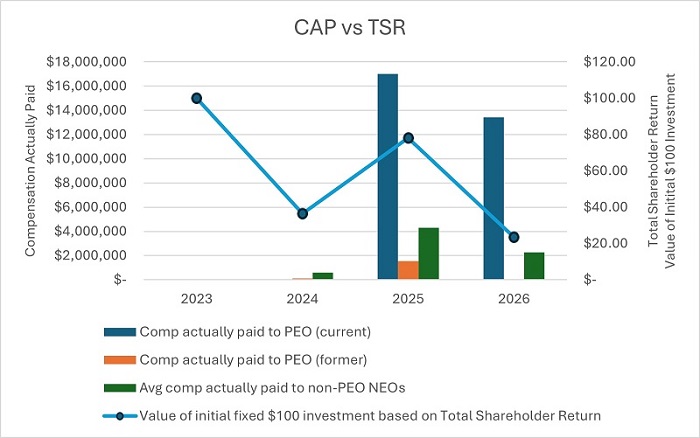
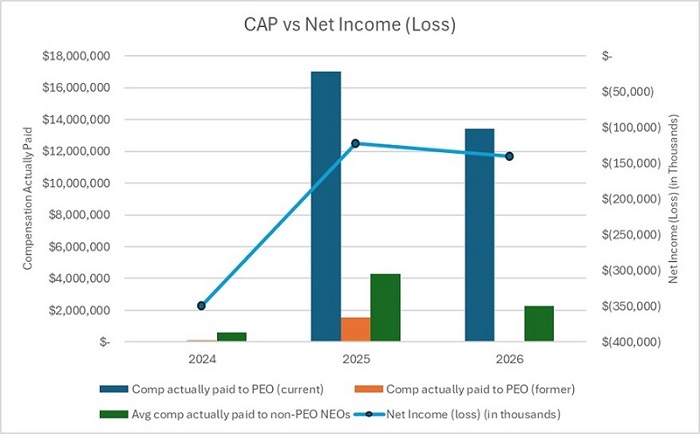
Policies and Practices Related to the Grant of Certain Equity Awards Close in Time to the Release of Material non-Public Information
EQUITY COMPENSATION PLAN INFORMATION
The following table provides information as of January 31, 2026, with respect to shares of our common stock that may be issued under our existing equity compensation plans.
|
Number of Shares to be issued upon |
Weighted average |
Number of securities remaining available for future issuance under equity compensation |
||||||||||
|
Plan Category |
exercise of outstanding options, warrants and rights (#) (a) |
exercise price of outstanding options, warrants and rights (b) |
plans (excluding securities reflected in column (a)) (#) (c) |
|||||||||
|
Equity Compensation plans approved by security holders (1) |
1,630,519 | $215.00 | 946,217 | (3) | ||||||||
|
Equity compensation plans not approved by security holders (2) |
217,082 | $230.00 | 206,252 | |||||||||
|
Total |
1,847,601 | $227.91 | 1,152,469 | |||||||||
|
(1) |
Shares reported in column (a) were all issued under the 2020 Plan and include: 1,049,069 shares underlying unvested RSUs; 80,724 shares underlying vested RSUs, where receipt of the underlying shares have been deferred at the election of the grantee; 492,626 shares underlying outstanding PSUs; and 8,100 shares underlying outstanding stock options. Column (b) does not take shares underlying RSUs and PSUs into account, as such awards do not have an exercise price. The number of shares to be issued in respect of outstanding PSUs assumes that the maximum level of performance applicable to the PSUs will be achieved. |
|
(2) |
Shares reported in column (a) consist of: (i) the following awards granted pursuant to the Skillsoft Corp. 2024 Employment Inducement Incentive Plan, as amended (the “Inducement Plan”) described below: 110,000 shares underlying unvested RSUs to 7 individuals, and 57,082 shares underlying unvested PSUs to 3 of the same individuals (assuming in each case that the maximum level of performance will be achieved); and (ii) 50,000 shares underlying warrants awarded to former chief executive officer, Jeffrey Tarr (“Tarr Warrants”). The Tarr Warrants have an expiration date of June 11, 2026. Column (b) does not take shares underlying RSUs and PSUs into account, as such awards do not have an exercise price. Column (c) consists of awards remaining available for grant under the Inducement Plan. |
|
(3) |
These shares are available for grant as of January 31, 2026 under the 2020 Plan. Under the 2020 Plan, the Compensation Committee may make various share-based awards including incentive stock options, nonqualified stock options, stock appreciation rights, restricted stock, RSUs, PSUs, other equity-based awards, and cash-based awards. The maximum number of shares that may be granted under the 2020 Plan was originally 655,295 (after adjustment for a reverse stock split), without giving effect to subsequent “evergreen” increases, pursuant to which the plan share reserve is automatically increased on January 1 of each year in an amount equal to five percent of the total number of shares of common stock outstanding on December 31 of the preceding calendar year (unless the Compensation Committee determines that there will be no January 1 increase for a given year or that the increase for a given year will be a less than the five percent of the outstanding shares as described above). The 2020 Plan was amended in 2024 to increase the number of shares that may be granted thereunder to 2,908,333, prior to the effect of any “evergreen” increase for fiscal 2025 and subsequent years described above. The number in this column represents the number of shares remaining available for future issuance on January 31, 2026, following the January 1, 2026 evergreen increase of 438,089 shares, and does not include the additional shares that would be reserved for issuance under the 2020 Plan in the event that Proposal No. 3 (Second Amendment to the 2020 Plan) is duly approved by our stockholders. |
The Inducement Plan was adopted on May 16, 2024, and amended on June 5, 2025. The Inducement Plan provides for inducement grants of nonqualified stock options, stock appreciation rights, restricted stock, restricted stock units, other equity-based awards, and cash-based incentive awards to new hires, or individuals being rehired following a bona fide period of non-employment with the Company, in compliance with Section 303A.08 of the New York Stock Exchange Listed Company Manual. Under the Inducement Plan, as amended, 400,000 shares are authorized for issuance. As of January 31, 2026, 206,252 shares remained available for issuance thereunder, and as of May 4, 2026, 111,667 shares remain available for issuance thereunder.
SECURITY OWNERSHIP OF CERTAIN BENEFICIAL OWNERS AND MANAGEMENT
The following table sets forth information known to us regarding the beneficial ownership of shares of our common stock as of May 4, 2026, by:
|
• |
each person (or group, as that term is used in Section 13(d)(3) of the Exchange Act) who is the beneficial owner of more than 5% of the outstanding shares of our common stock; |
|
• |
each of our NEOs and directors; and |
|
• |
all of our current executive officers and directors as a group. |
Beneficial ownership is determined according to the rules of the SEC, which generally provide that a person has beneficial ownership of a security if he, she, or it possesses sole or shared voting or investment power over that security, including securities that such person has the right to acquire within 60 days. Except as described in the footnotes below, and subject to applicable community property laws and similar laws, we believe that each person listed below has sole voting and investment power with respect to such shares. None of our directors or officers had any shares pledged as collateral as of May 4, 2026.
The beneficial ownership of shares of our common stock is based on 8,955,077 shares of common stock issued and outstanding on May 4, 2026.
There are no arrangements currently known to us, the operation of which may at a subsequent date result in a change of control of the Company.
|
Shares of Common Stock Beneficially Owned |
||||||||
|
Name and Address of Beneficial Holder (1) |
Number of Shares |
Percentage of Shares |
||||||
|
5% stockholders |
||||||||
|
MIH Learning B.V. (2) |
3,896,418 |
39.8 |
% |
|||||
|
Michael S. Klein (3) |
1,050,427 |
11.1 |
% |
|||||
|
Paradice Investment Management LLC (4) |
610,289 |
6.8 |
% |
|||||
|
Named executive officers and directors: |
||||||||
|
Ronald W. Hovsepian (5) |
310,099 |
3.5 |
% |
|||||
|
John Frederick (6) |
26,645 |
* |
|
|||||
|
Matthew Glitzer (7) |
43,407 | * | ||||||
|
Helena B. Foulkes (8) |
13,750 |
* | ||||||
|
Jim Frankola (9) |
45,306 |
* | ||||||
|
Arthur Gilliland (10) |
- |
- | ||||||
|
Michael S. Klein (3) |
1,050,427 |
11.1 |
% |
|||||
|
Karen G. Mills (11) |
25,574 |
* | ||||||
|
Denis Nikolaev |
- | - | ||||||
|
Paul Peake |
- | - | ||||||
|
Peter Schmitt (12) |
5,100 |
* | ||||||
|
All current directors and executive officers as a group (13 persons) (13): |
1,536,650 |
16.2 |
% |
|||||
|
* |
Less than 1% |
|
(1) |
Unless otherwise noted, the address of each of the following entities or individuals is c/o Skillsoft Corp., 300 Innovative Way, Suite 2210, Nashua, NH 03062. |
|
(2) |
Based on the Form 4 filed with the SEC by Naspers Ltd. (“Naspers”) on September 21, 2022, reporting shares of common stock owned by MIH Learning B.V. (“MIH”), MIH beneficially owns 3,063,085 shares of common stock. Additionally, MIH holds 833,333 shares of common stock that may be issued upon the exercise of vested warrants issued pursuant to the MIH Subscription Agreement. MIH is an indirect wholly owned subsidiary of Prosus N.V. Prosus N.V. is a direct subsidiary of Naspers. Naspers holds ordinary shares of Prosus N.V. that, based upon such Form 4, represent approximately 72.4% of the voting rights in respect of Prosus N.V.’s shares. As a result, shares of common stock beneficially owned by MIH may be deemed to be beneficially owned by Prosus N.V. and by Naspers. Prosus N.V. is a publicly traded limited liability company incorporated under the laws of the Netherlands. Naspers is a publicly traded limited liability company incorporated under the laws of the Republic of South Africa. The business address (i) for MIH and Prosus N.V. is Symphony Offices, Gustav Mahlerplein 5, 1082 MS Amsterdam, The Netherlands, and (ii) for Naspers is Media24 Centre, 40 Heerengracht, Cape Town, South Africa 8001. |
|
(3) |
Based on a Schedule 13G/A of M. Klein Associates, Inc. filed with the SEC on February 14, 2024, reporting shares of common stock beneficially owned as of December 31, 2023 and information provided to the Company, interests shown consist of 26,906 shares of common stock held directly, and indirect beneficial ownership of (i) 334,716 shares of common stock held by a trust beneficially owned by Mr. Klein; (ii) 347,798 shares of common stock issuable upon the exercise of vested warrants held by M. Klein Associates, Inc., of which Mr. Klein is the controlling stockholder and (iii) 177,984 shares of common stock and 163,023 shares of common stock issuable upon the exercise of vested warrants held by Garden State Capital Partners, LLC, of which Mr. Klein is the managing member. Excludes 12,430 shares issuable upon the vesting of RSUs held directly by Mr. Klein that may be settled in shares or cash at the election of the Compensation Committee. The business address for Mr. Klein is 640 Fifth Avenue, 12th Floor, New York, New York 10019. |
|
(4) |
Based on a Schedule 13G/A of Paradice Investment Management LLC and Paradice Investment Management Pty Ltd filed with the SEC on October 7, 2025, reporting shares of common stock beneficially owned as of September 30, 2025. Includes (i) shared power to vote or direct to vote 60,792 shares, and (ii) shared power to dispose of or direct the disposition of 610,289 shares. The business address for Paradice Investment Management LLC is 257 Fillmore Street, Suite 200, Denver, CO 80206 and the business address of Paradice Investment Management Pty Ltd is Level 27, Chifley Tower, 2 Chifley Square, Sydney, NSW 2000, Australia. |
|
(5) |
Excludes all unvested PSUs and 433,570 shares issuable upon the vesting of RSUs that may be settled in shares or cash at the election of the Compensation Committee, and 6,600 shares of common stock underlying vested RSUs issued to Mr. Hovsepian when he was solely a director of the Company, the receipt of which has been irrevocably deferred pursuant to Mr. Hovsepian’s election. |
|
(6) |
Excludes all unvested PSUs and 96,250 shares issuable upon the vesting of RSUs that may be settled in shares or cash at the election of the Compensation Committee. |
|
(7) |
Excludes all unvested PSUs and 80,626 shares issuable upon the vesting of RSUs that may be settled in shares or cash at the election of the Compensation Committee. |
|
(8) |
Excludes (i) 23,055 shares issuable upon the vesting of RSUs that may be settled in shares or cash at the election of the Compensation Committee, and (ii) 23,156 shares of common stock underlying vested RSUs, the receipt of which has been irrevocably deferred at the director’s election. |
|
(9) |
Excludes 29,305 shares issuable upon the vesting of RSUs that may be settled in shares or cash at the election of the Compensation Committee. |
|
(10) |
Excludes 31,250 shares issuable upon the vesting of RSUs that may be settled in shares or cash at the election of the Compensation Committee. |
|
(11) |
Interests shown consist of indirect beneficial ownership of (i) 6,674 shares of common stock and 6,113 shares of common stock issuable upon the exercise of vested warrants held by K&BM LP, an entity affiliated with Ms. Mills, and (ii) 6,674 shares of common stock and 6,113 shares of common stock issuable up on the exercise of vested warrants held by Mills Family I, LLC, an entity affiliated with Ms. Mills. Excludes (i) 23,055 shares issuable upon the vesting of RSUs that may be settled in shares or cash at the election of the Compensation Committee, and (ii) 26,906 shares underlying vested RSUs, the receipt of which has been irrevocably deferred at the director’s election. |
|
(12) |
Excludes (i) 12,430 shares issuable upon the vesting of RSUs that may be settled in shares or cash at the election of the Compensation Committee, and (ii) 24,056 shares of common stock underlying vested RSUs, the receipt of which has been irrevocably deferred at the director’s election. |
|
(13) |
Includes 523,047 shares of common stock issuable upon the exercise of currently vested warrants. Excludes all unvested PSUs and 789,471 shares issuable upon the vesting of RSUs that may be settled in shares or cash at the election of the Compensation Committee. |
CERTAIN RELATIONSHIPS AND RELATED PERSON TRANSACTIONS
Related Person Transactions are defined as transactions (or a series of similar transactions) during our last two completed fiscal years or currently proposed, to which we were a participant or will be a participant, in which:
|
• |
the amounts involved exceeded or will exceed the lesser of $120,000 or one percent of the average of our total assets at year-end for the last two completed fiscal years; and |
|
• |
any of our directors, executive officers, director nominees, stockholders (or groups) known to us to beneficially hold more than 5% of any class of our voting securities, or an immediate family member of any of the foregoing (any of the foregoing persons, a “Related Person”) had or will have a direct or indirect material interest. |
Other than as described below (and other than Board or executive compensation arrangements not required to be disclosed under Regulation S-K Item 404(a)), there have not been, nor are there any currently proposed, transactions or series of similar transactions meeting these criteria to which we have been or will be a participant.
Agreements with Prosus and Affiliates
In January 2025, Skillsoft renewed a previous three-year agreement (which was for an aggregate amount of $0.7 million) to provide off-the-shelf Skillsoft products to companies affiliated with Prosus (collectively known as “Prosus Companies”) for an aggregate of $0.8 million over the next three years (the “Prosus Commercial Agreement”). In March 2024, Skillsoft entered into a one-year commercial arrangement to provide training and coaching services to Prosus Companies in the amount of $84,000. These services were not provided in 2024 and were therefore extended in March 2025 for another year (collectively, the “Coaching Arrangement”). In June 2025, the parties consolidated these arrangements and added certain upgraded licenses (the “2025 Consolidation”). The 2025 Consolidation includes Skillsoft's customary automatic one-year renewal term unless terminated by either party upon specified advance notice. However, the Coaching Arrangement portion terminated in January 2026. In April 2025, the parties also entered into an additional one-year off-the-shelf product agreement for specific training products for approximately $69,000 and in March 2026, the parties added a number of additional licenses to the 2025 Consolidation for the remaining term of the three-year agreement for approximately $40,000 per year.
The agreements with Prosus Companies and the payment of the fees described above were each approved by the Company’s Audit Committee in accordance with the Company’s Related Party Transaction Policy (as described below) and represent transactions in line with the Company’s standard pricing policies and practices. Prosus, through its indirect ownership of MIH, beneficially owns approximately 40% of the Company’s common stock.
Related Person Transactions Policy
We have adopted a formal written policy for the reporting, review and approval or ratification of transactions with Related Persons. Our Related Person Transaction Policy provides that we will only enter into a Related Person Transaction when our Audit Committee determines that the transaction is in the best interests of the Company and our stockholders. In connection with approving or ratifying a Related Person Transaction, our Chief Legal Officer, or his or her designee (“CLO”) (either alone or together with the Chair of the Board and/or the Chair of the Audit Committee) will review all reported transactions to determine whether the proposed transaction could be a Related Person Transaction. If it is determined that a proposed transaction could be a Related Person Transaction, our CLO reports the transaction, along with a summary of material facts, to the Audit Committee for review.
The Audit Committee will take into account all of the relevant facts and circumstances available to it, including, among any other factors it deems appropriate:
|
● |
the relationship of the Related Person with the Company; |
|
● |
the materiality of the transaction, including the dollar value of the transaction, without regard to profit or loss; |
|
● |
the business purpose for the transaction (including the anticipated profit or loss from the transaction), taken in the context of the alternatives available to the Company; |
|
● |
whether the transaction is on arms-length terms; |
|
● |
whether the transaction is in the ordinary course of the Company’s business; |
|
● |
the effect of the transaction on the Company’s business and operations, including on the Company’s internal control over financial reporting and system of disclosure controls and procedures, and any additional conditions or controls (including reporting and review requirements) that should be applied to such transaction; |
|
● |
the potential for the transaction to lead to an actual or apparent conflict of interest; |
|
● |
any safeguards imposed to prevent actual or apparent conflicts of interest; and |
|
● |
the overall fairness of the transaction to the Company. |
Availability of Certain Information
A copy of our Annual Report has been posted on the Internet along with this Proxy Statement, each of which is accessible by following the instructions in the Notice. The Annual Report is not incorporated into this Proxy Statement and is not considered proxy soliciting material.
We filed our 2026 Form 10-K with the SEC on April 7, 2026. We will mail without charge, upon written request, a copy of this Proxy Statement or our 2026 Form 10-K, including financial statements and any financial statement schedules, but excluding exhibits. Exhibits to the 2026 Form 10-K will be provided upon request and payment of the Company’s reasonable expenses in connection therewith. Please send a written request to:
Skillsoft Corp.
Attention: Investor Relations
300 Innovative Way, Suite 2210
Nashua, NH 03062
(603) 324-3000
We have adopted a procedure, approved by the SEC, called “householding.” Under this procedure, stockholders of record who have the same address and last name will receive only one copy of the Notice or, if requested, our Proxy Statement and Annual Report unless we are notified that one or more of these stockholders wishes to receive individual copies. This procedure reduces our printing costs and postage fees.
If you are eligible for householding, but you and other stockholders of record with whom you share an address currently receive multiple copies of the Notice, or, if requested, our Proxy Statement and Annual Report, or if you hold our stock in more than one account, and in either case you wish to receive only a single copy of each of these documents for your household, please contact our Corporate Secretary by mail, c/o Skillsoft Corp., 300 Innovative Way, Suite 2210, Nashua, NH 03062 or by phone at (603) 324-3000. If you participate in householding and wish to receive a separate copy of the Notice or, if requested, this Proxy Statement and our Annual Report, or if you do not wish to continue to participate in householding and prefer to receive separate copies of these documents in the future, please contact our Corporate Secretary as indicated above and we will promptly deliver such separate copies.
If you are the beneficial owner of shares held in street name through a broker, bank, or other intermediary, please contact your broker, bank, or intermediary directly if you have questions, require additional copies of the Notice, this Proxy Statement, or our Annual Report or wish to receive a single copy of such materials in the future for all beneficial owners of shares of our common stock sharing an address.
Stockholder Proposals and Nominations for the 2027 Annual Meeting of Stockholders
In order to include a stockholder proposal in our proxy statement and form of proxy for the annual meeting of stockholders to be held in 2027 (the “2027 Annual Meeting”), we must receive the proposal at our principal executive offices, addressed to the Corporate Secretary, no later than the close of business on January 8, 2027. However, if the date of the 2027 Annual Meeting is changed by more than 30 days from the anniversary date of the 2026 Annual Meeting, then the deadline will be a reasonable time before we begin to print and send our proxy materials.
Any stockholder proposal or director nomination submitted to us for consideration at the 2027 Annual Meeting but which is not intended to be included in the related proxy statement and form of proxy, must be delivered to our Corporate Secretary in writing not earlier than the close of business (as defined in our Bylaws) on February 25, 2027 and not later than the close of business on March 26, 2027. In the event that the date of the 2027 Annual Meeting is more than 30 days before or more than 70 days after June 25, 2027 (the anniversary of the 2026 Annual Meeting), we must receive the proposal or nomination not earlier than the close of business on the 120th day prior to the 2027 Annual Meeting and not later than the close of business on the later of the 90th day prior to the 2027 Annual Meeting date or the 10th day following the date on which public announcement of the 2027 Annual Meeting is first made. If a stockholder does not meet these deadlines, the proposal or nomination will be considered by us to be untimely and not properly brought before the 2027 Annual Meeting, and the persons appointed as proxies for the 2027 Annual Meeting will be allowed to use their discretionary voting authority when and if the matter is raised at the meeting.
Stockholders who wish to submit a proposal or a director nominee must meet the eligibility and rule requirements of the SEC and comply with the requirements of our Bylaws (which are attached as Exhibit 3.2 to our Current Report on Form 8-K filed on June 17, 2021, available at https://investor.skillsoft.com/sec-filings or the SEC’s website at www.sec.gov, or upon request to our Corporate Secretary by mail, c/o Skillsoft Corp., 300 Innovative Way, Suite 2210, Nashua, NH 03062).
In addition to satisfying the foregoing requirements, to comply with the SEC’s universal proxy rules, stockholders who intend to solicit proxies in support of director nominees other than our nominees must provide notice that sets forth the information required by Rule 14a-19 under the Exchange Act no later than April 26, 2027, 60 days before the anniversary of the 2026 Annual Meeting. If the date of the 2027 Annual Meeting has changed by more than 30 calendar days from the anniversary of the 2026 Annual Meeting, the stockholder would have to provide notice by the later of 60 calendar days before the date of the 2027 Annual Meeting or the 10th calendar day after the company’s first public announcement of the date of the 2027 Annual Meeting.
The Annual Meeting is called for the purposes set forth in the Notice of Meeting. Our Board does not know of any other matters to be considered by the stockholders at the Annual Meeting other than the matters described in the notice. However, the enclosed proxy confers discretionary authority on the persons named in the Proxy Card with respect to matters that may properly come before the Annual Meeting and that are not known to our Board at the date this Proxy Statement was printed. It is the intention of the persons named in the Proxy Card to vote in accordance with their best judgment on any such matter.
Non-GAAP Financial Measures
In addition to disclosing detailed operating results in accordance with U.S. GAAP, Skillsoft provides supplementary non-GAAP financial measures to consider in evaluating our operating performance. We track the non-GAAP financial measures that we believe are key financial measures of our success. Non-GAAP measures are frequently used by securities analysts, investors, and other interested parties in their evaluation of companies comparable to us, many of which present non-GAAP measures when reporting their results. These measures can be useful in evaluating our performance against our peer companies because we believe the measures provide users with valuable insight into key components of U.S. GAAP financial disclosures. In addition, management uses these non-GAAP financial measures to assess operating performance, financial leverage and the effective use and allocation of resources; to provide more normalized period-to-period comparisons of operating results; to enhance investors’ understanding of the core operating results of our business; and to set management incentive targets. We believe investors use both U.S. GAAP and non-GAAP financial measures to assess management's decisions associated with our priorities and capital allocation, as well as to analyze how our business operates in, or responds to, macroeconomic trends or other events that impact our core operations. We disclose the non-GAAP financial measures included in this proxy statement because we believe that they provide meaningful supplemental information. However, non-GAAP financial measures have limitations as analytical tools. Because not all companies use identical calculations, our presentation of non-GAAP financial measures may not be comparable to other similarly titled measures of other companies. They are not presentations made in accordance with U.S. GAAP, are not measures of financial condition or liquidity, and should not be considered as an alternative to profit or loss for the period determined in accordance with U.S. GAAP or operating cash flows determined in accordance with U.S. GAAP. As a result, these non-GAAP financial measures should not be considered in isolation from, or as a substitute analysis for, results of operations as determined in accordance with U.S. GAAP.
The non-GAAP financial measures included in this Proxy Statement are: Adjusted EBITDA, Adjusted EBITDA margin %, free cash flow, and solely with respect to the disclosure of incentive target levels:
TDS CC Revenue, TDS CC Adjusted EBITDA, Business TDS Bookings, and Business Skillsoft Bookings. The Compensation Committee establishes annual incentive compensation targets on a constant currency basis, because foreign exchange rate fluctuations are outside of management’s control and can obscure underlying business trends, and we believe utilizing constant currency results to neutralize foreign currency volatility aligns the incentives with operational performance.
These non-GAAP measures are defined as follows:
Adjusted EBITDA - is defined as net income (loss) excluding non-cash items, discrete and event-specific costs that do not represent normal cash operating expenses necessary for our business operations, and certain accounting income and/or expenses. Management believes these exclusions enhance the comparability of our results from period to period, and as compared to peers, and are useful in assessing our operating performance, and consist of the following (including the related tax effects), when applicable to the periods presented:
|
● |
Impairment charges - Non-cash goodwill and intangible asset impairment charges. |
|
|
● |
Amortization of acquired intangible assets – Non-cash amortization expense of finite-lived intangible assets recognized as a part of business combination accounting. |
|
|
● |
Acquisition and integration related costs – Costs incurred to effectuate an acquisition, including contingent compensation expenses, and integration-related costs. |
|
|
● |
Restructuring charges – Charges related to strategic cost saving initiatives, including severance costs, losses associated with the abandonment of right-of-use assets, and contract termination costs. |
|
|
● |
Transformation costs – Costs incurred to transform our operations through significant strategic non-ordinary course transactions. |
|
|
● |
System migration costs – Costs of temporary resources needed for the migration of content and customers from our legacy system to a global platform. |
|
|
● |
Long-term incentive compensation expenses – Charges associated with long-term incentive compensation programs, including stock-based compensation, cash awards tied to stock performance, and awards granted in-lieu of stock that are intended to be settled in cash. |
|
|
● |
Executive exit costs – Costs associated with the departure of executives. |
|
|
● |
Fair value adjustments – Mark-to-market adjustments of interest rate swap agreements. |
|
|
● |
Other (income) expense, net – Unrealized and realized gains or losses primarily resulting from fluctuations of U.S. dollar appreciating or depreciating against other currencies, and impairments associated with property and equipment and other tangible assets when their carrying values are not recoverable. |
|
|
● |
Amortization of capitalized internally developed software– Non-cash amortization expense for finite-lived intangible assets other than those recognized as a part of business combination accounting. |
|
|
● |
Interest expense, net – Gross interest expense offset by interest income |
|
|
● |
Depreciation expense – Non-cash depreciation expense for property and equipment assets. |
|
|
● |
Provision for (benefit from) income taxes – Current and deferred federal, state and foreign income tax expense (benefit). |
Adjusted EBITDA margin % - is defined as adjusted EBITDA as a percentage of revenue.
Bookings (which are disclosed as targets only) is defined as contractually committed agreements to provide products and/or services to a customer, with the value representing the amount of revenue expected to be recognized in an annual period, on a constant currency basis. Revenue is not recognized until it is earned under our policies and US GAAP. Business TDS Bookings are Bookings for the TDS segment less Bookings associated with the Company’s consumer business. Business Skillsoft Bookings are Bookings for Skillsoft Corp. To calculate the constant currency adjustment, we translated local currency amounts into US dollars using the applicable currency exchange rates from June 2024.
Free cash flow is defined as net cash provided by (used in) operating activities, less net purchases of property and equipment and internally developed software. Note that free cash flow does not represent residual cash flow available to Skillsoft for discretionary expenditures.
TDS CC Adjusted EBITDA (which is disclosed as targets only) is defined as TDS segment net income (loss), excluding non-cash items, discrete and event-specific costs that do not represent normal cash operating expenses necessary for our business operations, and certain accounting income and/or expenses attributable to the TDS segment, and consist of the following (when applicable): impairment charges, amortization of acquired intangible assets, acquisition and integration-related costs, restructuring charges, transformation costs, system migration costs, long-term incentive compensation expenses, executive exit costs, fair value adjustments of interest rate swap agreements, other (income) expense, net, amortization of capitalized internally developed software, interest expense, net, depreciation expense, and provision for (benefit from) income taxes (each as described above), determined on a constant currency basis. To calculate the constant currency adjustment, we translated local currency amounts into US dollars using the applicable currency exchange rates from June 2024.
TDS CC Revenue (which is disclosed as targets only) is defined as TDS segment revenue, determined on a constant currency basis. To calculate the constant currency adjustment, we translated local currency amounts into US dollars using the applicable currency exchange rates from June 2024.
|
SKILLSOFT CORP. |
||||||
|
RECONCILIATION OF NON-GAAP FINANCIAL MEASURES |
||||||
|
(in thousands, unaudited) |
||||||
|
Twelve Months Ended January 31, |
||||||||
|
2026 |
2025 |
|||||||
|
Revenues |
||||||||
|
Talent Development Solutions |
$ | 403,745 | $ | 405,530 | ||||
|
Global Knowledge |
108,929 | 125,464 | ||||||
|
Total revenues, as reported |
$ | 512,674 | $ | 530,994 | ||||
|
Net income (loss), as reported |
$ | (139,824 | ) | $ | (121,908 | ) | ||
|
Amortization of acquired intangible assets (1) |
115,334 | 118,642 | ||||||
|
Impairment of goodwill and intangible assets |
31,716 | — | ||||||
|
Acquisition and integration related costs |
1,379 | 4,247 | ||||||
|
Restructuring charges |
17,318 | 18,273 | ||||||
|
Transformation costs |
4,674 | 1,567 | ||||||
|
System migration costs |
— | 118 | ||||||
|
Long-term incentive compensation expenses |
14,868 | 20,602 | ||||||
|
Executive exit costs |
— | 3,326 | ||||||
|
Fair value adjustment of interest rate swaps |
3,733 | (1,287 | ) | |||||
|
Other (income) expense, net |
3,696 | (677 | ) | |||||
|
Tax impact of adjustments |
(17,210 | ) | (7,416 | ) | ||||
|
Interest expense, net |
56,611 | 59,990 | ||||||
|
Expense (benefit from) income taxes, excluding tax impacts above |
3,501 | 1,677 | ||||||
|
Depreciation |
1,817 | 3,374 | ||||||
|
Amortization of capitalized internally developed software (1) |
12,012 | 8,574 | ||||||
|
Adjusted EBITDA |
$ | 109,625 | $ | 109,102 | ||||
|
(1) |
All amortization (not only amortization pertaining to finite-lived intangible assets recognized as part of business combination accounting) is excluded in the determination of Adjusted EBITDA. |
|
SKILLSOFT CORP. |
|
FREE CASH FLOW |
|
(in thousands, unaudited) |
|
Twelve Months Ended January 31, |
||||
|
2026 |
||||
|
Free cash flow reconciliation |
||||
|
Net cash provided by (used in) operating activities |
$ | 25,050 | ||
|
Purchase of property and equipment, net |
(1,766 | ) | ||
|
Internally developed software - capitalized costs |
(16,786 | ) | ||
|
Free cash flow |
6,498 | |||
|
SKILLSOFT CORP. |
|
TALENT DEVELOPMENT SOLUTIONS |
|
RECONCILIATION OF NON-GAAP CORPORATE BONUS TARGET MEASURES |
|
(in thousands, unaudited) |
|
Year Ended January 31, |
||||
|
2026 |
||||
|
Total TDS Segment revenues, as reported |
$ | 403,745 | ||
| Foreign currency impact | (2,345 | ) | ||
| TDS CC Revenue | $ | 401,400 | ||
|
TDS Segment Net income (loss) (1) |
$ | (84,140 | ) | |
|
Amortization of acquired intangible assets (2) |
109,131 | |||
|
Impairment of goodwill and intangible assets |
10,945 | |||
|
Acquisition and integration related costs |
1,361 | |||
|
Restructuring charges |
15,542 | |||
|
Transformation costs |
4,674 | |||
|
System migration costs |
— | |||
|
Long-term incentive compensation expenses |
13,680 | |||
|
Executive exit costs |
— | |||
|
Fair value adjustment of interest rate swaps |
3,733 | ) | ||
|
Other (income) expense, net |
(10,695 | ) | ||
|
Tax impact of adjustments |
(14,267 | ) | ||
|
Interest expense, net |
56,692 | |||
|
Expense (benefit from) income taxes, excluding tax impacts above |
2,355 | |||
|
Depreciation |
1,333 | |||
|
Amortization of capitalized internally developed software (2) |
12,012 | |||
|
TDS Segment Adjusted EBITDA |
122,356 | |||
| Foreign currency impact | 1,856 | |||
|
TDS CC Adjusted EBITDA |
$ | 120,500 | ||
|
(1) |
The TDS and GK net income (loss) amounts combined agree with the aggregate amount reported in the Company’s consolidated statements of operations included in the 2026 Form 10-K for fiscal 2026. |
|
(2) |
All amortization (not only amortization pertaining to finite-lived intangible assets recognized as part of business combination accounting) is excluded in the determination of TDS Segment Adjusted EBITDA. |
|
DETERMINATION OF |
|
BOOKINGS |
|
(in thousands, unaudited) |
|
Twelve Months Ended January 31, |
||||
|
2026 |
||||
|
TDS: |
||||
|
Enterprise |
$ | 357,986 | ||
|
Consumer |
32,196 | |||
|
Total TDS bookings |
390,182 | |||
|
Foreign currency impact |
18 | |||
|
Business Skillsoft Bookings |
$ | 390,200 | ||
|
TDS Enterprise |
$ | 357,986 | ||
|
Foreign currency impact |
14 | |||
|
Business TDS Bookings |
$ | 358,000 | ||
SECOND AMENDMENT TO
SKILLSOFT CORP.
2020 OMNIBUS INCENTIVE PLAN
WHEREAS, Skillsoft Corp. (the “Company”), a Delaware corporation, sponsors the Skillsoft Corp. 2020 Omnibus Incentive Plan (the “Plan”);
WHEREAS, pursuant to Section 12(a) of the Plan, the Board of Directors of the Company (the “Board”) may amend the Plan at any time, subject to stockholder approval if the amendment would materially increase the number of securities which may be issued under the Plan; and
WHEREAS, the Board desires to amend the Plan to increase the number of shares of Common Stock (as defined in the Plan) available for awards under the Plan, subject to the approval of the Company’s stockholders.
NOW, THEREFORE, the Plan is hereby amended, subject to and effective as of the date of the approval of the Company’s stockholders, as follows:
|
1. |
The first sentence of Section 6(a) of the Plan is amended and restated in its entirety as follows: |
Subject to Section 11 of the Plan, and subject to any annual increases described in this Section 6(a) below beginning on January 1, 2027, 4,305,658 shares of Common Stock (the “Plan Share Reserve”) shall be available for Awards under the Plan.
|
2. |
Except as set forth above, all other provisions of the Plan shall remain in effect unaffected hereby. |
IN WITNESS WHEREOF, the Board has adopted the Second Amendment to Skillsoft Corp. 2020 Omnibus Incentive Plan on March 25, 2026, subject to and effective as of the date of the approval of the Company’s stockholders.